
Bode’s and Cigar Galaxies
Two neighboring galaxies, one graceful and one violent, showing what gravity can do across millions of years.
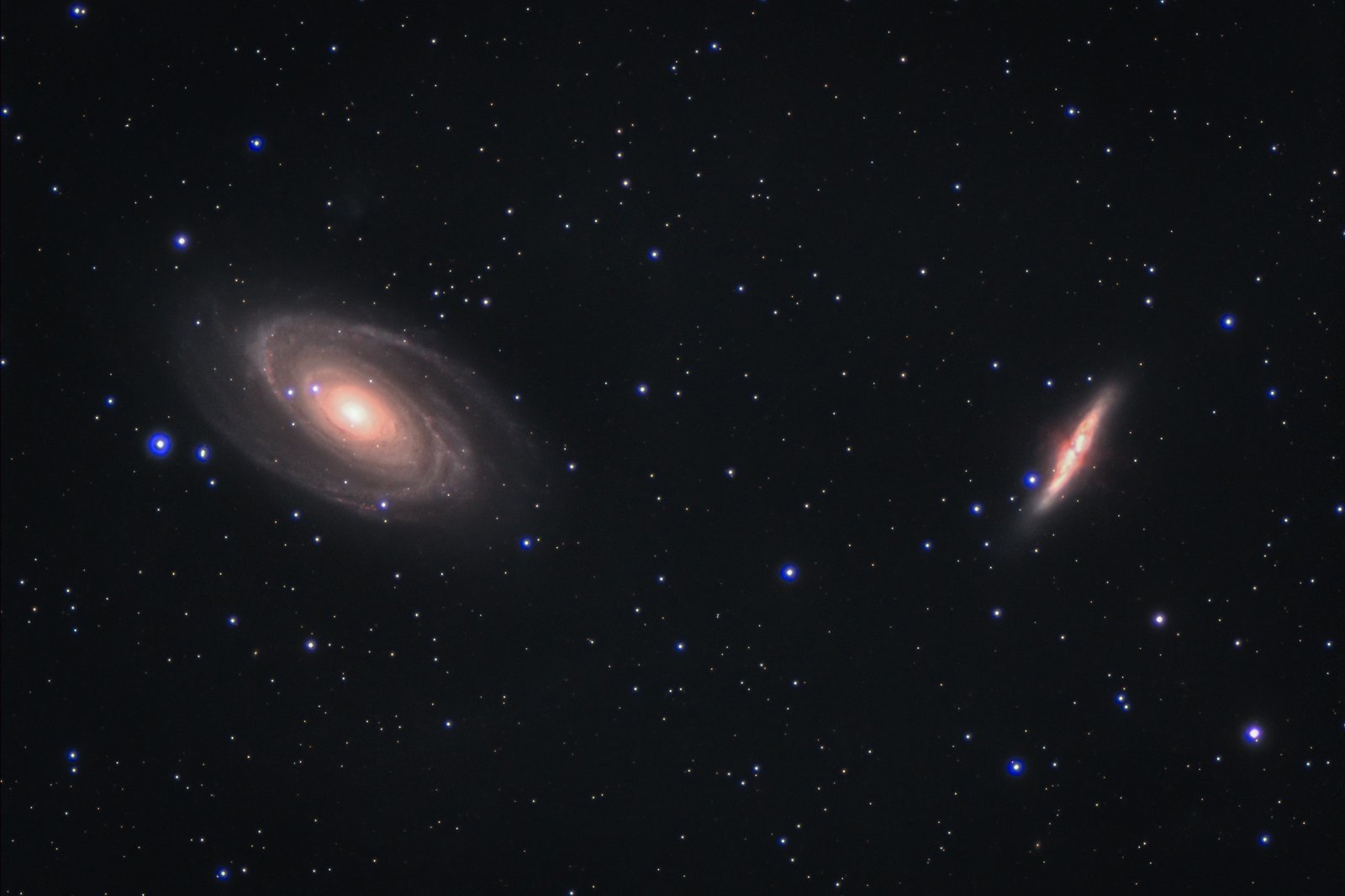
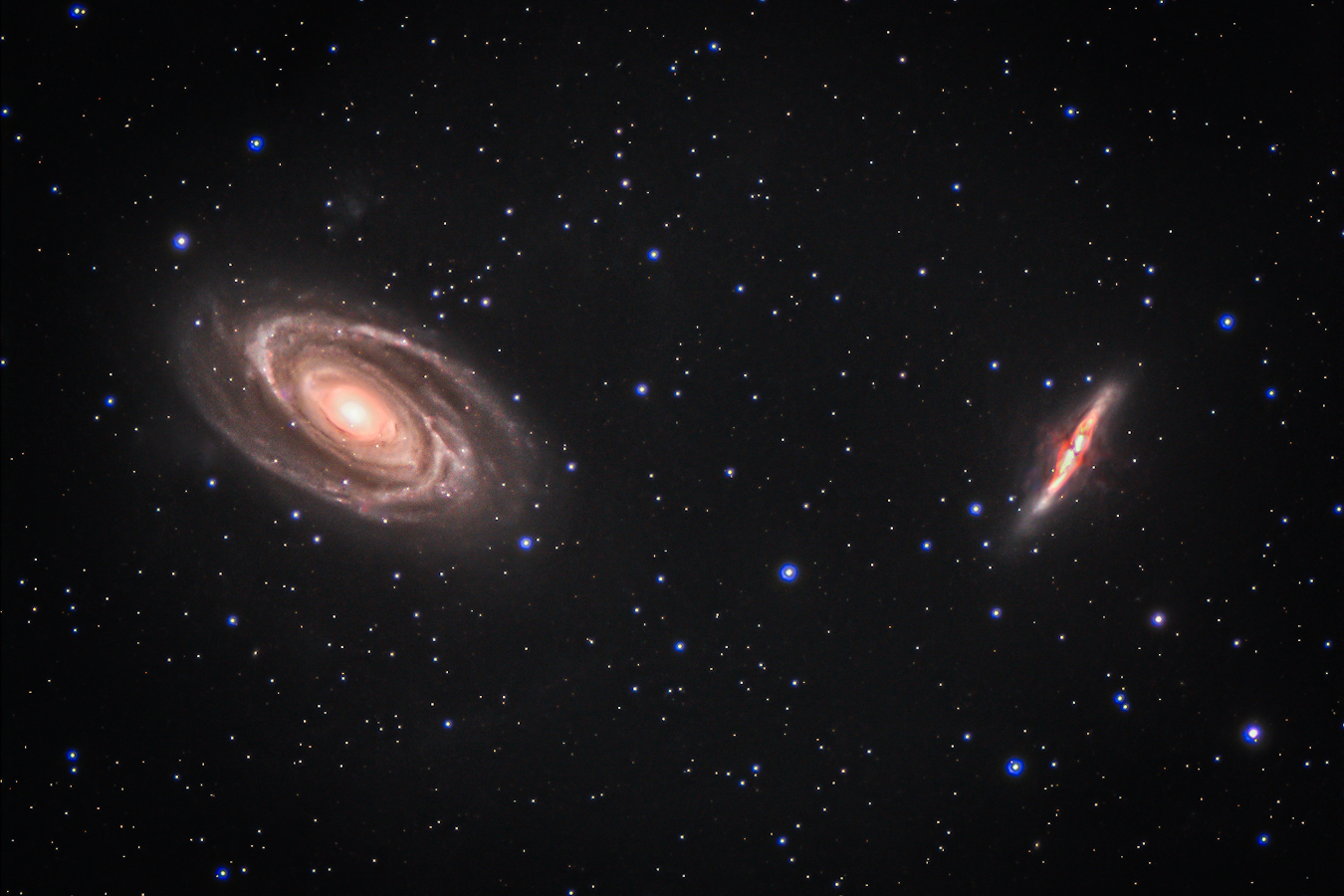
In Ursa Major, M81 and M82 fit comfortably inside the same telescopic field. Their apparent closeness is not merely a trick of perspective. The two galaxies are part of the same nearby group and have interacted gravitationally in the past.
That interaction helped turn them into one of the best visual contrasts in the galaxy sky.
M81: structure and symmetry
M81, Bode’s Galaxy, is a grand-design spiral roughly comparable in scale to the Milky Way. Its arms curve cleanly around a bright central region, threaded with dust and young stellar populations.
Seen in photographs, M81 looks composed. Its spiral pattern is easy to read, and its overall form resembles the classic idea of what a spiral galaxy should be.
But the calm appearance is incomplete. Gravity from neighboring galaxies has influenced the distribution of gas in the M81 Group, leaving evidence that even apparently stable galaxies participate in larger interactions.
M82: a galaxy pushed into overdrive
M82 could hardly look more different. Viewed nearly edge-on, the Cigar Galaxy is narrow, irregular, dusty, and intensely active.
It is undergoing a powerful period of star formation—a starburst—driven in large part by past gravitational encounters with M81. Those interactions compressed gas inside M82, helping trigger rapid formation of massive young stars.
Massive stars do not live long. Their winds and supernova explosions inject enormous energy into the surrounding medium. In M82, that collective activity drives material outward from the galaxy’s central regions in a spectacular superwind.
Hydrogen-alpha images reveal reddish filaments extending above and below the disk, as though the galaxy is venting into intergalactic space.
Gravity as an architect
Galaxies are often described as island universes, but islands can collide.
Close encounters redistribute gas, distort disks, trigger star formation, and sometimes end in complete mergers. The process may unfold over hundreds of millions or billions of years, far too slowly to watch directly, but nearby interacting systems let astronomers reconstruct the sequence from structure and motion.
M81 and M82 offer both halves of the story in one field: an orderly spiral and a companion whose recent history has been far more turbulent.
At the telescope
Both galaxies are accessible to amateur observers under reasonably dark skies. M81 appears as a soft oval with a brighter center. M82 is thinner and often looks more textured, with its elongated form standing out clearly.
For astrophotographers, the pair works beautifully at moderate focal lengths because both can be framed together. Longer focal lengths reveal dust structure in M81 and the disturbed central regions of M82. Adding hydrogen-alpha data can bring out the starburst-driven outflow surrounding the Cigar Galaxy.
Calm and chaos are neighbors
The attraction of the pair is partly aesthetic. One galaxy looks elegant. The other looks damaged. But the deeper point is that those appearances are connected.
M82’s chaos is not random. It is a record of relationship.
Gravity does not need to touch anything to transform it. Across enormous distances, two galaxies can rewrite each other simply by passing close enough.