
We Keep Looking Up
Astronomy is full of numbers too large to imagine, distances too far to cross, and objects we will never touch. Somehow that has never stopped us from looking.
There is no practical reason most people need to know where the Andromeda Galaxy is.
It will not help with traffic. It will not cook dinner. Knowing the difference between a planetary nebula and a supernova remnant is unlikely to save a meeting or fix a leaking pipe.
And yet people have named stars for thousands of years.
They built stories around constellations, tracked planets, predicted eclipses, crossed oceans by the sky, raised observatories on mountains, launched telescopes above the atmosphere, and spent entire lives studying light that left its source before human civilization existed.
Utility is clearly not the whole explanation.
The sky is a scale we cannot control
Daily life is built at human scale. Distances are measured in miles. Time is measured in appointments, seasons, birthdays, generations. Astronomy breaks those units almost immediately.
A light-year is already too large to experience directly. A galaxy contains hundreds of billions of stars. Cosmic history extends for billions of years. Even the nearest stars are beyond any journey we currently know how to make.
The numbers should make the universe feel abstract.
Instead, the opposite often happens. One good view through a telescope can make those impossible distances feel strangely immediate.
Looking is a form of contact
When photons from a galaxy enter a telescope, no spacecraft has crossed the distance. Nothing has been brought closer. But information has arrived.
The light carries structure, color, motion, composition, temperature, and history. Astronomy works because light can cross a distance we cannot.
To observe is therefore not passive. It is to receive something that actually came from the object.
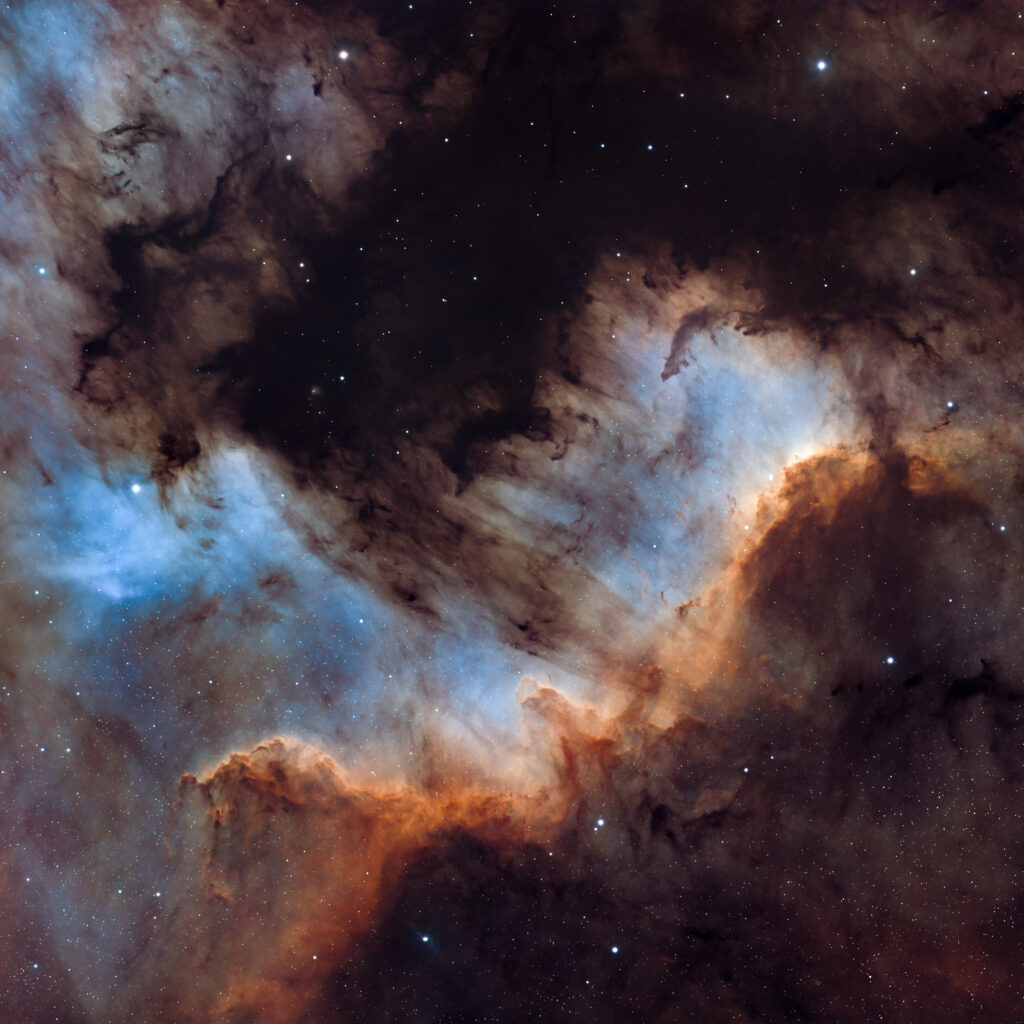
A telescope does not merely show us a picture of Saturn. It redirects Saturn’s light into our eyes. A camera aimed at a nebula counts photons that physically left that region of space.
The connection is thin, but it is real.
Wonder survives explanation
One of the best things about astronomy is that understanding an object rarely ruins it.
Knowing that the Orion Nebula is ionized gas surrounding young stars does not make it less beautiful. Understanding that Saturn’s rings are countless pieces of ice and rock does not make them ordinary. Learning that the colors in a nebula come from specific atomic transitions does not drain the color of meaning.
Explanation can deepen wonder because it replaces vagueness with relationship.
The stars stop being decorative lights and become suns. The dark patches become molecular clouds. The faint smudge becomes another galaxy.
So we keep looking
Maybe that is the simplest reason.
The sky keeps offering evidence that reality is larger than the part of it required for survival. There are things worth knowing simply because they are there. There are places we may never visit that still deserve attention. There are questions with no immediate use that still enlarge the person asking them.
We look up because the universe is not ours, because it is larger than us, and because for a little while the light allows us to belong to it anyway.