
When the Sky Falls
A meteor lasts only seconds, but its flash connects planetary debris, orbital mechanics, atmosphere, and the oldest human habit of looking up.
A meteor is almost nothing by the time we notice it. A grain, a pebble, a fragment left behind by a comet or asteroid. Then Earth meets it at tremendous speed and the night briefly writes a line of fire.
The entire event can be over before there is time to point.
That impermanence is part of the beauty. Deep-sky astronomy rewards patience with objects that appear fixed. Meteor watching rewards attention with things that refuse to wait.
The atmosphere becomes visible
We usually look through the atmosphere as though it were not there. Meteors make it obvious. As a small particle plunges into the upper atmosphere at high velocity, collisions compress and heat the gas around it. Material ablates away. Excited atoms emit light. A glowing trail appears high above the ground.
The phrase “shooting star” is wonderfully inaccurate. No star is falling. The stars remain distant and indifferent while a tiny piece of solar-system debris burns above us.
Why showers return
Meteor showers are not random appointments. Earth follows the same orbit around the Sun each year, and at certain points it crosses streams of debris deposited along the orbits of comets or, in some cases, asteroids.
The result is recurrence. Perseids in one season. Geminids in another. Leonids, Orionids, Quadrantids. The dates return because Earth returns.
From our perspective, shower meteors seem to radiate from a common area of sky. That radiant is a perspective effect, like parallel tracks appearing to meet in the distance. The meteoroids are entering on roughly parallel paths while we observe them from a moving world.
The best equipment is often none
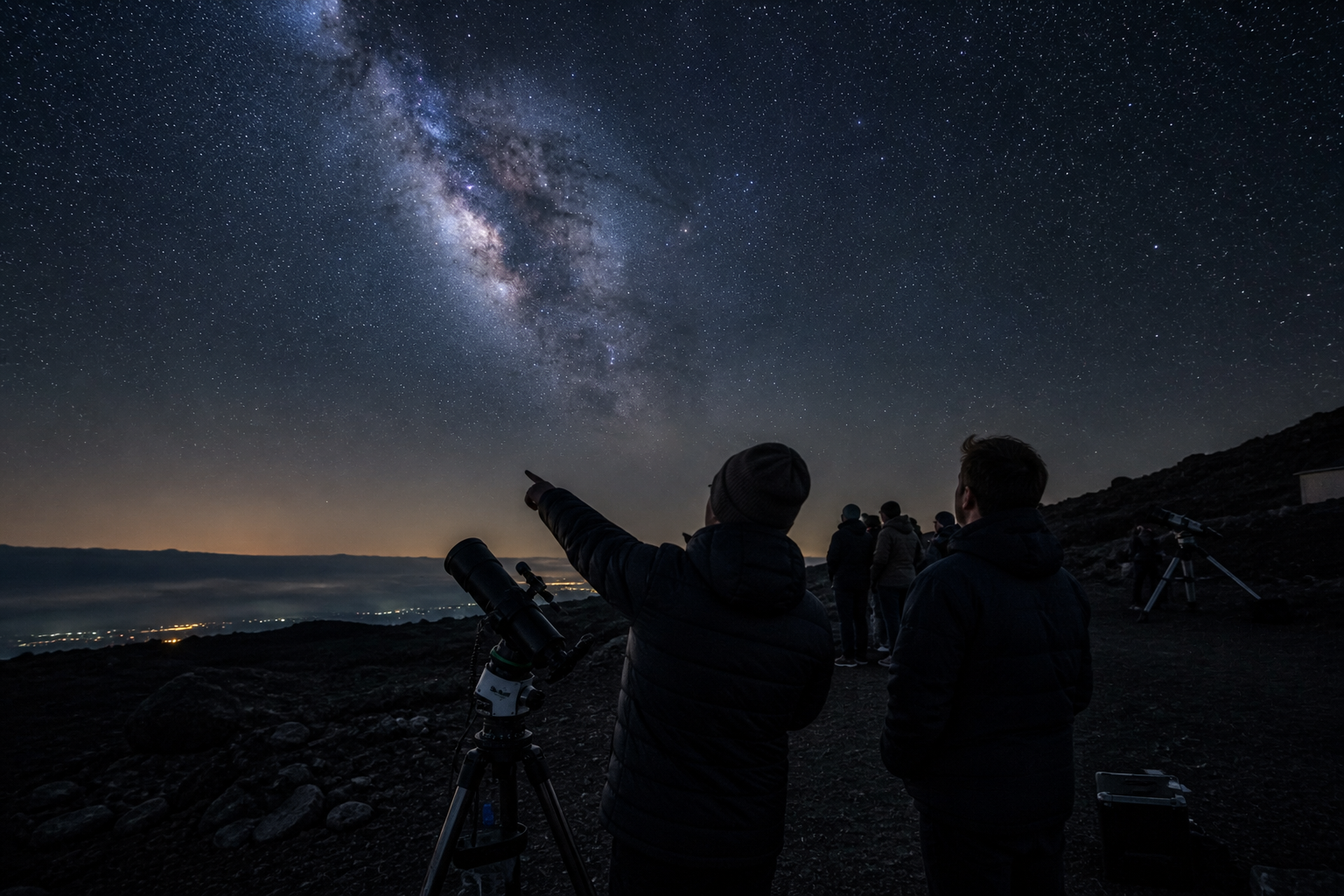
Meteor observing is one of the rare parts of astronomy where a telescope can make things worse. A narrow field of view is the opposite of what you want. The ideal instrument is often simply a dark place, a comfortable position, enough time, and two functioning eyes.
It is astronomy stripped of machinery.
There is also something communal about it. A telescope usually gathers people around one eyepiece. A meteor shower points everyone at the whole sky. Someone sees a bright one. Someone else misses it. The next meteor belongs to somebody different.
Brief things can still be cosmic
A meteor may last a second, but the material that creates it can be ancient. It can have spent millions or billions of years as part of the solar system before its final encounter with Earth’s atmosphere.
Duration is not the same as significance.
For a moment, a piece of the solar system becomes light. Then the sky closes behind it as though nothing happened.