
Why Nebulae Glow
Nebulae look like painted clouds, but their colors are not decoration. They are light produced, reflected, filtered, and blocked by matter in space.
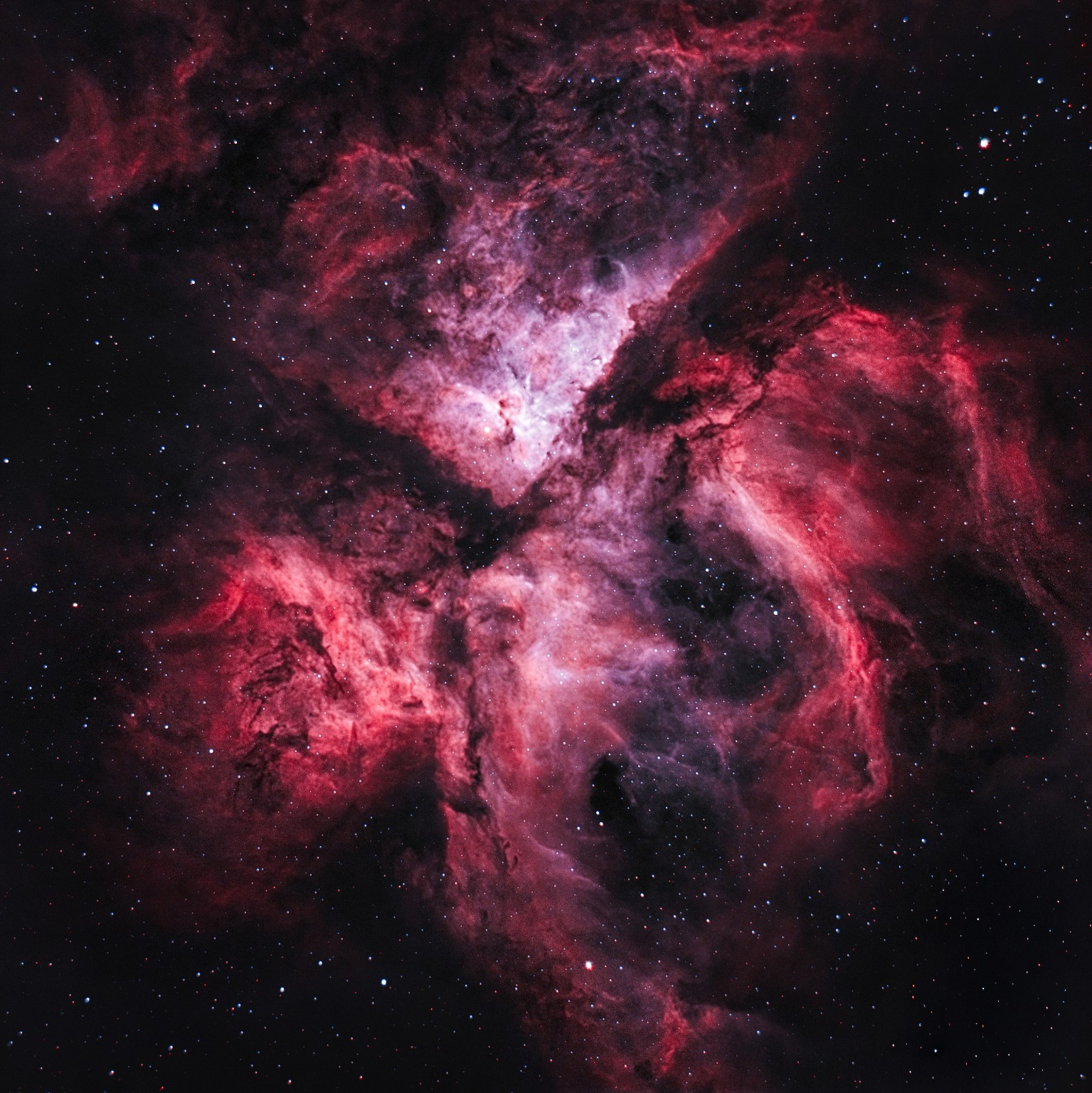
A nebula can look impossible in a photograph. Red walls fold around blue stars. Dark pillars stand in front of glowing gas. Delicate shells stretch across space like smoke caught in a breeze that does not exist.
It is tempting to call the colors artistic. In reality, the art belongs to physics.
Some clouds make their own visible light
In an emission nebula, hot young stars flood surrounding gas with ultraviolet radiation. That radiation can ionize atoms, stripping electrons away. When electrons later recombine or move between energy states, the gas emits light at specific wavelengths.
Hydrogen is especially important. One of its strongest visible emission lines, hydrogen-alpha, lies in the red part of the spectrum. That is why so many star-forming regions become richly red in broadband and narrowband images.
Oxygen can contribute strong blue-green emission, and sulfur contributes additional red wavelengths. Narrowband astrophotography isolates these emissions and lets us map structures that would otherwise be difficult to separate from background light.
Some nebulae borrow light
Reflection nebulae work differently. Their dust does not glow strongly in visible light on its own. Instead, it scatters the light of nearby stars.
Shorter blue wavelengths scatter efficiently, which is why reflection nebulae often appear blue. The effect is related to the same broad physics that makes Earth’s daytime sky blue, although the environment is entirely different.
The Pleiades are a famous example: brilliant stars moving through dusty material illuminate a soft blue web around themselves.
And some nebulae are visible because they are dark
Dark nebulae do not need to shine at all. Dense dust blocks whatever lies behind it. Against a bright emission region or crowded Milky Way star field, the cloud becomes visible as a silhouette.
The Horsehead is perhaps the most famous, but the sky is full of these negative shapes. They are not empty gaps. They are some of the densest concentrations of material in the field.
The image is a translation
Astrophotography always involves choices. Cameras have different sensitivities from human eyes. Filters isolate wavelengths. Processing stretches faint signal so structure becomes visible. Narrowband palettes may assign colors in ways designed to separate emissions rather than reproduce what the eye would see.
That does not make the image false. It makes it translated.
A weather map does not look like weather. An X-ray does not look like a bone to the naked eye. Scientific images often convert invisible or subtle information into a form the mind can read.
Good astrophotography can do the same while still being beautiful.
A nebula’s color is not merely what it looks like. It is part of the story of what the gas is, what the stars are doing to it, and how light is moving through the cloud.