

Why Darkness Is Not Empty
The night looks empty only because our eyes are impatient. Darkness is not the absence of the universe; it is the condition that allows the faintest parts of it to appear.
We speak about darkness as though it were a blank. A room goes dark. A road disappears. The landscape loses its edges. To human eyes, darkness feels like subtraction. But point a camera at the night for long enough and that idea begins to fall apart.
Leave the shutter open and darkness starts giving things back.
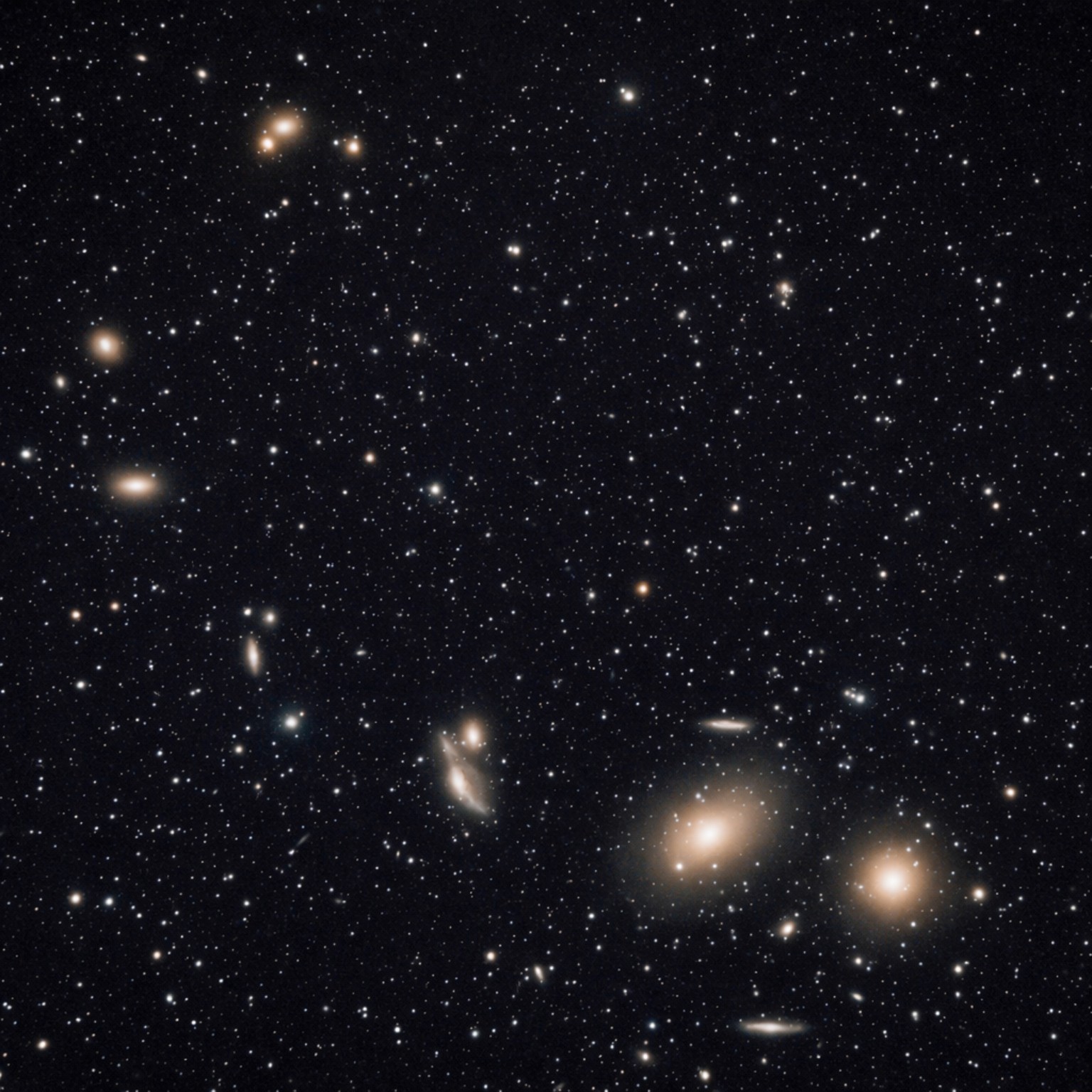
Stars too faint for the eye gather by the thousands. Dust lanes emerge where the Milky Way seemed smooth. Galaxies appear in patches of sky that looked perfectly vacant a moment before. The longer we look, the less empty the dark becomes.
The universe is mostly too faint for us
Human vision was not built to inventory the cosmos. It was built to keep an animal alive. Our eyes respond quickly, adapt to changing light, detect motion, and function across an enormous range of brightness. What they do not do especially well is collect individual photons for minutes or hours and patiently add them together.
A camera can. That difference is the foundation of deep-sky astrophotography.
In a single short exposure, a galaxy may be little more than a pale stain. Stack dozens or hundreds of exposures and its spiral arms begin to separate from the background. Dust becomes structure. Tiny knots of star formation begin to show color. The apparently empty sky was never empty. We simply had not gathered enough light to know what was there.
Darkness is contrast
True darkness is valuable not because nothing is present, but because less gets in the way. Moonlight, city glow, haze, and scattered artificial light raise the brightness of the sky itself. The faint universe is still there behind that glow, but the difference between object and background becomes smaller.
This is why a genuinely dark night can feel almost physical. The Milky Way stops looking like a pale stripe and starts showing texture. Dark nebulae cut into the star clouds. The spaces between familiar constellations fill with stars. The black regions become part of the picture rather than the absence of one.
In astronomy, black can contain information.
The dark has structure too
Some of the most beautiful things in the sky are visible precisely because they do not shine. Cold molecular clouds block the stars behind them, creating the Horsehead, the Coalsack, the winding lanes through the Milky Way, and countless unnamed silhouettes.
These clouds are not holes in space. They are matter: gas and microscopic grains of dust dense enough to absorb and scatter visible light. Inside many of them, gravity is quietly gathering material together. In places that look black to our eyes, stars are being assembled.
Darkness can be a nursery.
And beyond the visible
Even the darkness between galaxies is not truly nothing. Space contains radiation, fields, particles, thin gas, and matter we can infer through gravity even when we cannot see it directly. The universe is less like a collection of bright objects floating in a void and more like an enormous web whose faintest pieces are difficult to perceive from inside it.
That is part of what makes astronomy humbling. The visual sky is only a narrow slice of reality. Radio telescopes, infrared observatories, X-ray detectors, neutrino instruments, and gravitational-wave observatories all reveal versions of the universe our eyes will never experience directly.
So when the night looks black, it is worth remembering that black is not a verdict. It is a limit of perception.
The dark sky is not empty. It is unfinished information, waiting for enough patience, enough sensitivity, or the right kind of instrument to become visible.