
The Universe Writes in Dust
Dust is easy to mistake for obstruction. In astronomy, it is often the thing that gives the universe its shape.
Some of the most dramatic structures in the night sky are made from material whose defining feature is that it gets in the way.
Dust dims stars. It hides the center of our galaxy. It cuts black rivers through the Milky Way and turns bright nebulae into silhouettes. In photographs it can look like torn fabric, smoke, mountains, pillars, fingers, mouths, animals, coastlines—whatever shape the mind reaches for when confronted with darkness inside light.
But cosmic dust is not dirt floating between the stars. It is an archive of old stars and a raw material for new ones.
Small grains, enormous consequences
Interstellar dust grains are tiny, usually far smaller than anything visible to the eye. They can contain silicates, carbon-rich material, ice, and other compounds assembled in stellar atmospheres and explosive events. Yet spread across light-years, those microscopic grains become powerful enough to reshape what an entire region of space looks like.
Blue light is scattered and absorbed more efficiently than red light, which is one reason distant stars seen through dust can look reddened. Dense clouds may block visible light almost completely. Infrared wavelengths can pass through much of that dust more easily, revealing newborn stars hidden inside clouds that look opaque in ordinary photographs.
The same object can therefore appear empty, crowded, black, or luminous depending on the kind of light we choose to observe.
Where stars hide before they shine
Dense molecular clouds are among the coldest places in the galaxy. They do not look like factories. They look like absence. But where gravity causes parts of a cloud to collapse, stars begin assembling from the material around them.
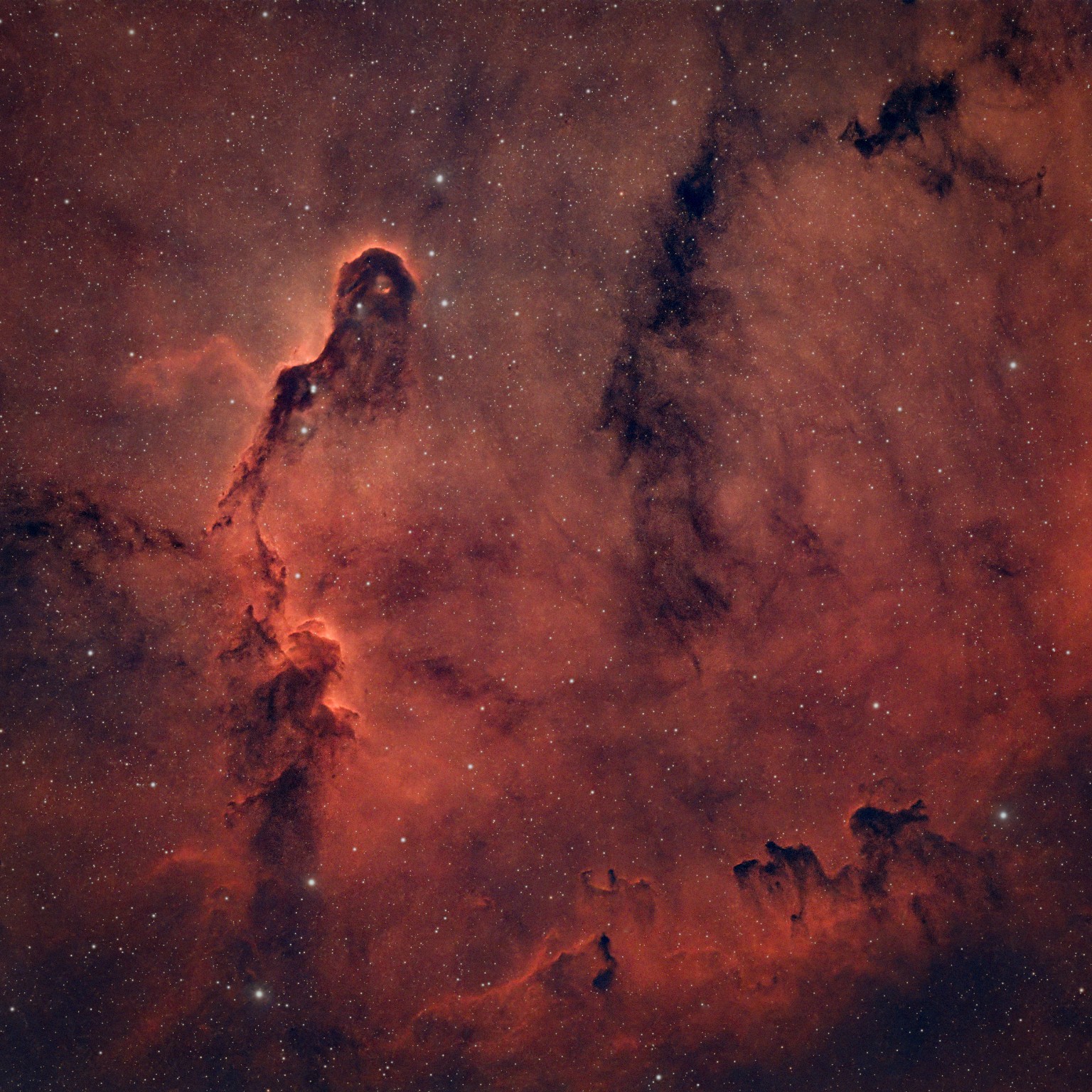
The Elephant’s Trunk is a beautiful example of that contradiction. Its dark shape is not a void carved into a nebula. It is a dense concentration of gas and dust standing in front of brighter ionized material. Radiation from nearby stars erodes and sculpts its surface while deeper inside, protected pockets of material can continue collapsing.
Creation is happening inside the silhouette.
Dust makes galaxies legible
On larger scales, dust lanes trace the architecture of spiral galaxies. Seen edge-on, a galaxy can be split by a dark equatorial band. Seen face-on, lanes of dust curl along spiral arms, often beside regions where new stars are forming.
Without dust, many galaxies would look smoother and less dramatic. With it, their structure becomes visible. Darkness outlines the geometry.
That is one of astronomy’s recurring lessons: something can hide light and still reveal truth.
Everything is recycled
There is something almost indecently beautiful about the cycle. Stars manufacture heavier elements in their interiors. Aging stars and stellar explosions return enriched material to space. Some of that material becomes dust. Dust joins cold clouds. Those clouds collapse. New stars and planets form.
The process is not clean or linear. It is violent, slow, wasteful, and astonishingly productive.
The calcium in bone, the iron in blood, the silicon in rock, the carbon in living cells—all belong to the same cosmic economy of matter. Dust is part of the middle chapter, when material that once belonged to one generation of stars waits in darkness for whatever comes next.
The universe does not only write with light. Sometimes it writes by removing light, tracing its sentences in shadow.