
A Photograph Made of Ancient Light
Astrophotography is strange: the camera is pointed at the present, but almost everything recorded happened in the past.
Every photograph is already a picture of the past. Light needs time to travel from a subject to a camera, even when the delay is too small to matter in ordinary life.
Astronomy simply stretches that delay until it becomes impossible to ignore.
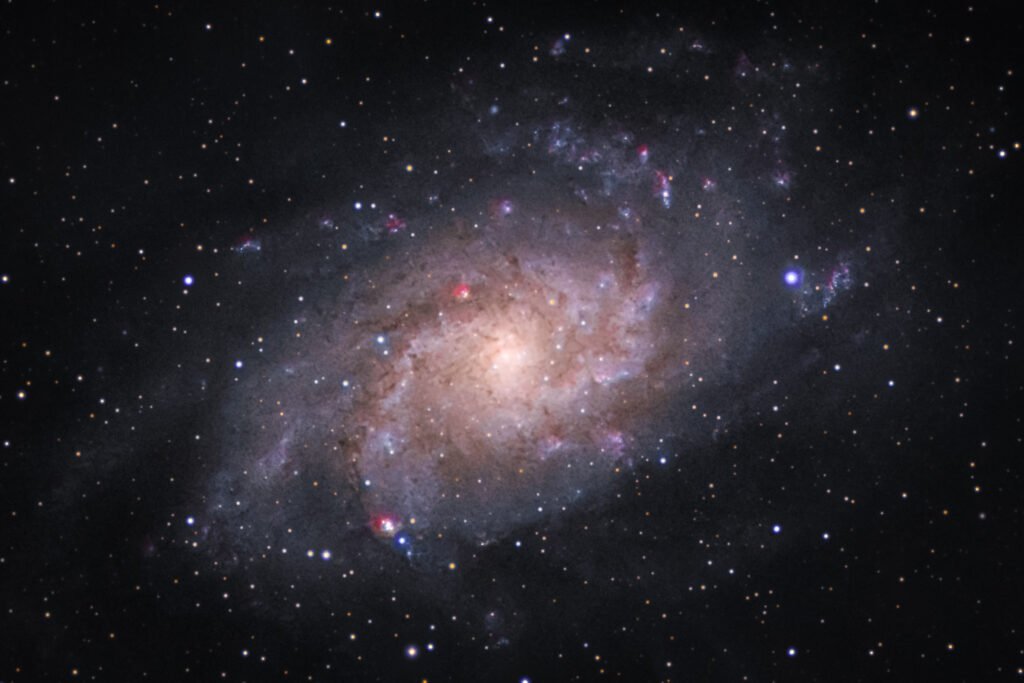
Photograph the Moon and the light in the frame is a little more than a second old. Photograph the Sun and the photons began their trip roughly eight minutes earlier. Photograph a bright nearby star and you may be collecting light that left years ago. Photograph the Triangulum Galaxy and the image is built from photons that crossed intergalactic space for millions of years before ending their journey in a sensor.
The shutter opens into history
This is one of the quietest miracles of astrophotography. Nothing dramatic happens when the exposure begins. The mount tracks. The camera counts photons. A faint gray shape slowly accumulates in data.
Yet the detector is receiving physical information that survived a journey across distances large enough to turn time into part of the composition.
When we process a galaxy image, we are not manufacturing detail from darkness. We are trying to recover a signal that arrived weak, scattered, contaminated by sky glow and atmosphere, but still carrying the structure of a remote object.
Long exposure is an act of patience
The faint sky does not usually surrender itself in one frame. The signal can be buried beneath noise. So we collect many exposures, calibrate them, align them, and combine them. Random noise becomes less dominant while consistent signal remains.
Hours of imaging are condensed into a single final photograph. In that sense the image contains two different kinds of time: the ancient travel time of the light itself and the modern hours spent gathering enough of it to see clearly.
One is cosmic. One is human. The finished image sits where they meet.
A camera can remember what an eye cannot
At the eyepiece, the faintest objects are immediate and fragile. You move your eye, lose dark adaptation, or let a cloud pass and the view changes. A camera can accumulate what the eye experiences only as hints.
That does not make the camera a replacement for looking. It makes it a different kind of looking.
The eye gives presence. The camera gives duration.
An astrophotograph is not a frozen moment. It is a collection of arrivals—old light, gathered patiently, made visible again.