

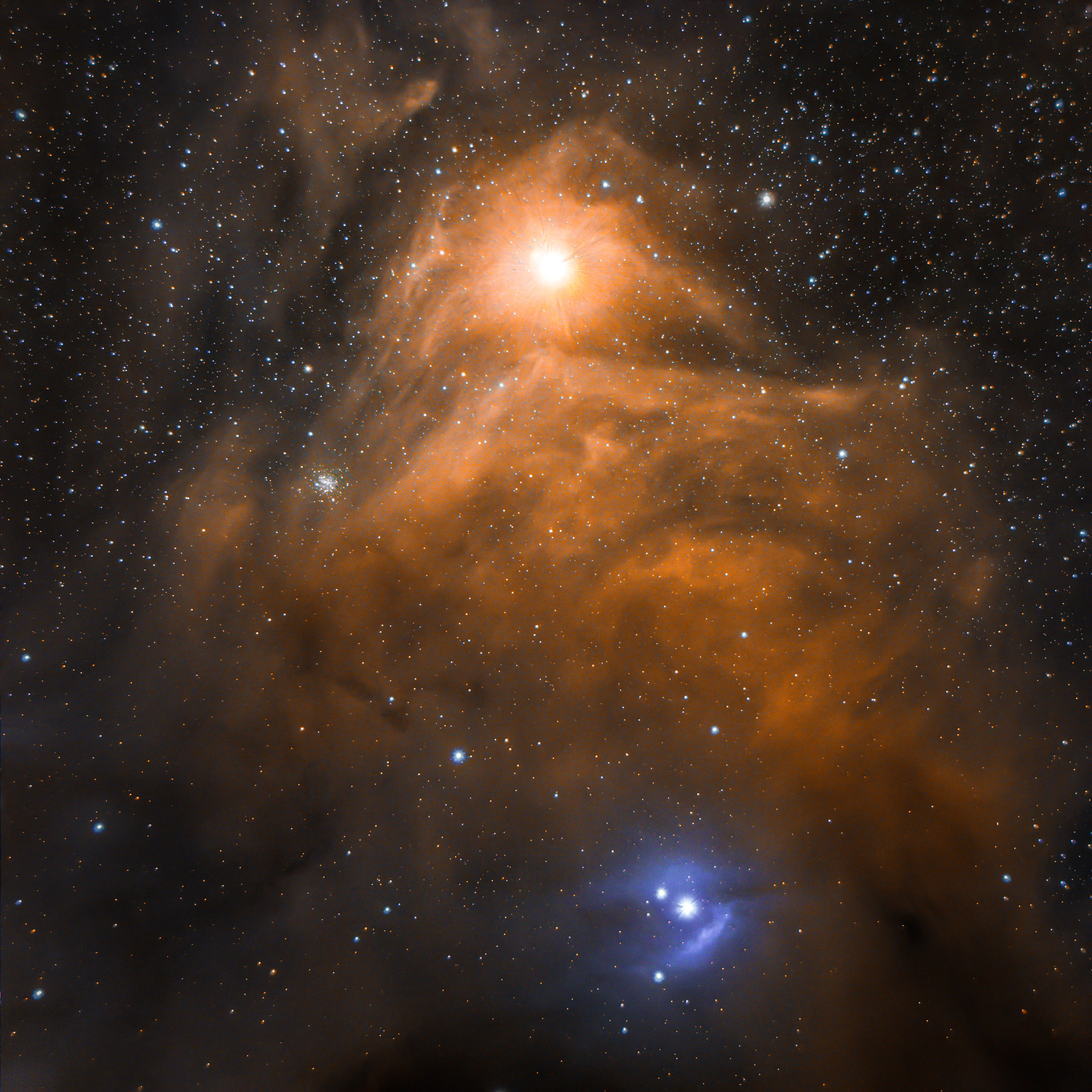
Antares and the Color of Ending
Antares burns with the color of a star nearing the end of one chapter of its life—a reminder that red in the sky can be both beautiful and temporary.
Antares is one of those stars that does not need a telescope to announce itself. It sits in Scorpius with a color strong enough to feel almost impossible, orange-red against a field of colder white and blue stars.
Its name comes from an old comparison with Mars: anti-Ares, the rival of the red planet. The resemblance is visual, but the two objects could hardly be more different. Mars is a small rocky world reflecting sunlight. Antares is a red supergiant—an enormous star generating its own light, already far along the path that massive stars follow toward their end.
A star swollen by age
Stars spend most of their lives in a kind of balance. Gravity pulls inward while energy produced in the core pushes outward. For a massive star, that balance evolves as the fuel in the core changes. Hydrogen gives way to later stages of fusion, the internal structure becomes more complicated, and the outer layers can expand to extraordinary dimensions.
That expansion cools the visible surface. Cooler does not mean dim. Antares is ferociously luminous. But its lower surface temperature shifts its visible color toward red and orange, giving it the unmistakable warmth we see from Earth.
Its color is therefore not decoration. It is information.
The strange beauty of late stellar life
There is a temptation to think of a red supergiant as a star simply dying. The truth is more interesting. The late life of a massive star is active, layered, and unstable. Material can be shed into surrounding space. Stellar winds carry enriched gas away from the star. Deep inside, fusion continues building heavier elements in successive stages.
Eventually, a sufficiently massive star can no longer support its core. Collapse follows, and a supernova may return an enormous amount of material to the galaxy in a single violent event.
Whether Antares explodes tomorrow in astronomical terms or far beyond any human lifetime, the direction of its evolution is clear: it is not a permanent fixture.
The sky only looks eternal
Constellations make the heavens feel fixed because a human life is short. The stars rise in familiar patterns. Orion returns. Scorpius returns. The Pleiades return. It is easy to imagine the sky as a painted ceiling rotating above us.
But every star is moving and changing. Some are being born. Some are quietly aging. Some have already died, though their light is still traveling toward us. The constellations are temporary alignments assembled by perspective and time.
Antares makes that truth easier to feel because its color looks alive. It seems to carry its history on its surface.
A red star in a colorful neighborhood
The region around Antares is also one of the richest areas of dust and reflection nebulosity in the sky. Blue reflected starlight, yellow and orange glow, dark molecular clouds, and the bright red star all overlap across the same field. Astrophotography turns the area into something almost painterly, but every color comes from a physical interaction between stars, dust, gas, and light.
That combination makes Antares more than a bright point in Scorpius. It becomes the anchor of an entire landscape.
To look at Antares is to see a star in the color of change. The universe does not hide age. Sometimes it lets a star wear it openly.