
PEGASUS GLOBULAR
CLUSTER
A fiercely concentrated sphere of ancient stars, with one of the densest cores of any globular cluster in the Milky Way.
Messier 15 is a massive globular cluster orbiting in the Milky Way’s halo. Hundreds of thousands of old stars are compressed into a brilliant, compact swarm roughly 33,600 light-years from Earth.
M15 is a core-collapsed cluster: gravity has packed its center so tightly that the stellar density rises dramatically toward the middle. That concentration creates the blazing core and finely resolved halo visible in this photograph.
Its ancient, metal-poor stars formed early in the history of the Milky Way. Globular clusters like M15 preserve a record of the Galaxy before generations of stars enriched interstellar space with heavier elements.
Into the
cluster.
A journey from the silent outskirts to a crowded stellar heart.
One swarm. Shared gravity.
A globular cluster is a roughly spherical swarm held together by the mutual gravity of its stars. Each star follows its own orbit through that shared pull. M15 is one of these clusters orbiting our Milky Way.
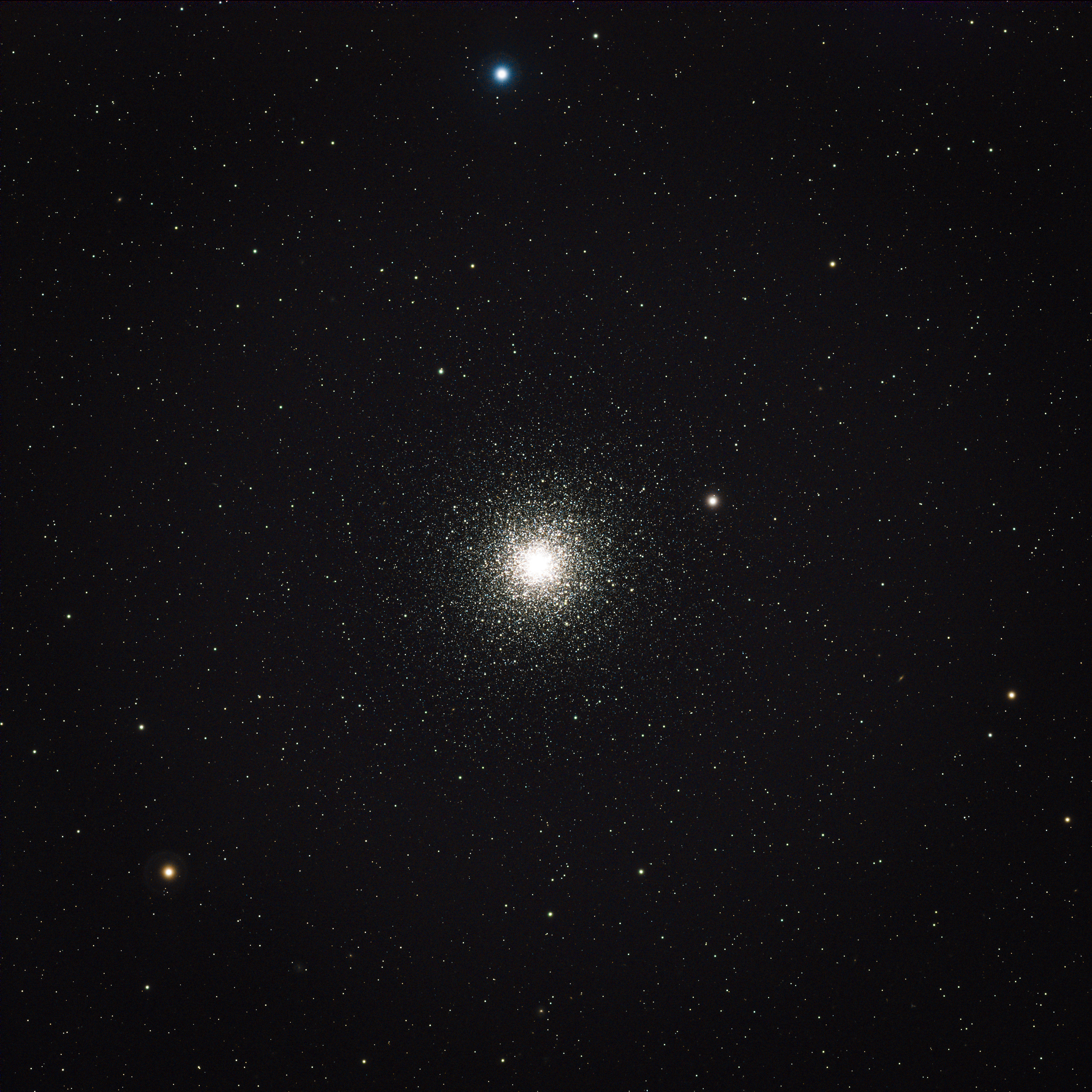 M15 · the real view ↗Photographed from HawaiʻiIllustrative 3D model. Star positions, stellar sizes, glow and travel time are schematic.
M15 lies within Pegasus, the winged horse of Greek mythology. Pegasus sprang from the blood of Medusa and later carried the hero Bellerophon into battle against the fire-breathing Chimera.
The cluster has no ancient myth of its own because it is too faint for the unaided eye. Jean-Dominique Maraldi discovered it in 1746, and Charles Messier added it to his catalog in 1764—placing a telescopic discovery inside one of the sky’s oldest legendary figures.
No traditional Hawaiian name is known for M15 itself. From Hawaiʻi, Pegasus climbs prominently into the eastern evening sky through late summer and autumn.
Press Play to follow Enif to Pegasus Globular Cluster. The guide identifies the constellation, traces the landmarks, then finishes with a precise bullseye.
Find
Pegasus Cluster
Follow the stars to Pegasus Globular Cluster.
A guided star hop to Pegasus Globular Cluster.
Tap Play to begin.
Chart notes & credits
This is a landmark chart, with north up and east left at its centre, rather than a live view for a particular date or horizon. Dashed lines connect catalogue landmarks; they are directions to sweep, not exact extensions of stellar pointer lines. Distances and directions are calculated from catalogue coordinates. Bullseyes mark reference positions, not objects’ size or visible brightness. The sky’s orientation changes as it moves. Star symbols are enlarged for clarity. Stars: ESA Hipparcos catalogue. Constellation lines: Stellarium Modern skyculture, adapted under CC BY-SA 4.0. Deep-sky reference positions: OpenNGC; individual source links below where applicable. Reference 1.
Select Play to begin. Tap the sky to pause or resume. Four step buttons revisit each landmark. The guide finishes with a stationary bullseye. Replay starts again. Reduced-motion preferences keep the waiting globe still.