
HAWAIʻI
AFTER DARK
A guided night of visual astronomy and live astrophotography built around the sky you actually have that evening. The season, Moon phase, weather, and best-placed objects determine where the night goes.
Hawaiʻi After Dark is built around the idea that a good astronomy night should never feel identical to the one before it. We begin with the sky that is actually overhead, then build the evening around the strongest targets available that night. Planets, the Moon, star clusters, double stars, nebulae, galaxies, and the Milky Way all move in and out of prime observing position through the year.
That means there is no canned list of ten objects we force into every tour. A late-summer night can be dominated by Sagittarius and Scorpius, autumn brings Andromeda, Cassiopeia and the Double Cluster, and winter hands the sky to Orion, the Pleiades, Jupiter, bright clusters, and the winter Milky Way.
The Moon matters just as much as the season. On darker nights we can push farther into faint deep-sky targets and subtle Milky Way structure. When the Moon is bright, we shift toward objects that thrive in moonlight: lunar terrain, planets, double stars, open clusters, globular clusters, and brighter nebulae.
We do not treat that as a compromise. A bright Moon can turn the night into an extraordinary close-up tour of another world, while a moonless sky opens the door to faint galaxies and nebulae that are much harder to see when the background sky is bright.
Learn the sky before looking through it.
We begin with a laser-guided orientation to the night sky. We identify the major constellations, bright stars, planets, seasonal landmarks, and the Milky Way when it is visible. You will learn how the sky is laid out and which objects we plan to visit through the telescopes.
The first telescope targets — and the imaging run begins.
We move to the 12-inch LX90 for our first visual observations while the imaging system locks onto a deep-sky target and begins collecting exposures. Depending on the night, the visual telescope might start on the Moon or a planet before moving into star clusters, nebulae, or galaxies.
Go deeper and compare what the eye sees with what the camera records.
We continue rotating through the best visual targets while checking the imaging system as data accumulates. This is where you can compare a subtle gray nebula at the eyepiece with the much fainter structure and color revealed by an astronomical camera gathering light over time.
Return to the best views and see what the camera captured.
We use the last part of the night to revisit favorite visual targets, catch anything newly risen or especially sharp, answer questions, and look at how the imaging data has developed. The exact timing stays flexible because the sky — not a stopwatch — decides what is worth spending time on.
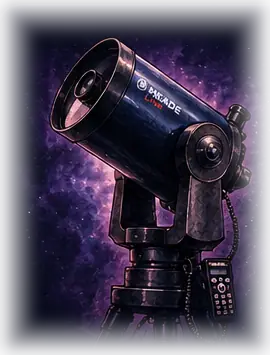
12-inch Meade LX90
The LX90 is the telescope you’ll look through throughout the night. Its 12-inch aperture brings planets, double stars, clusters, bright nebulae, and distant galaxies into a direct visual view, while interchangeable eyepieces let us change magnification to suit each target.
Choose your night.
Each date is its own reservation because the Moon and seasonal sky change the experience. Select an available night and guest count below. Each tour is capped at ten guests.