

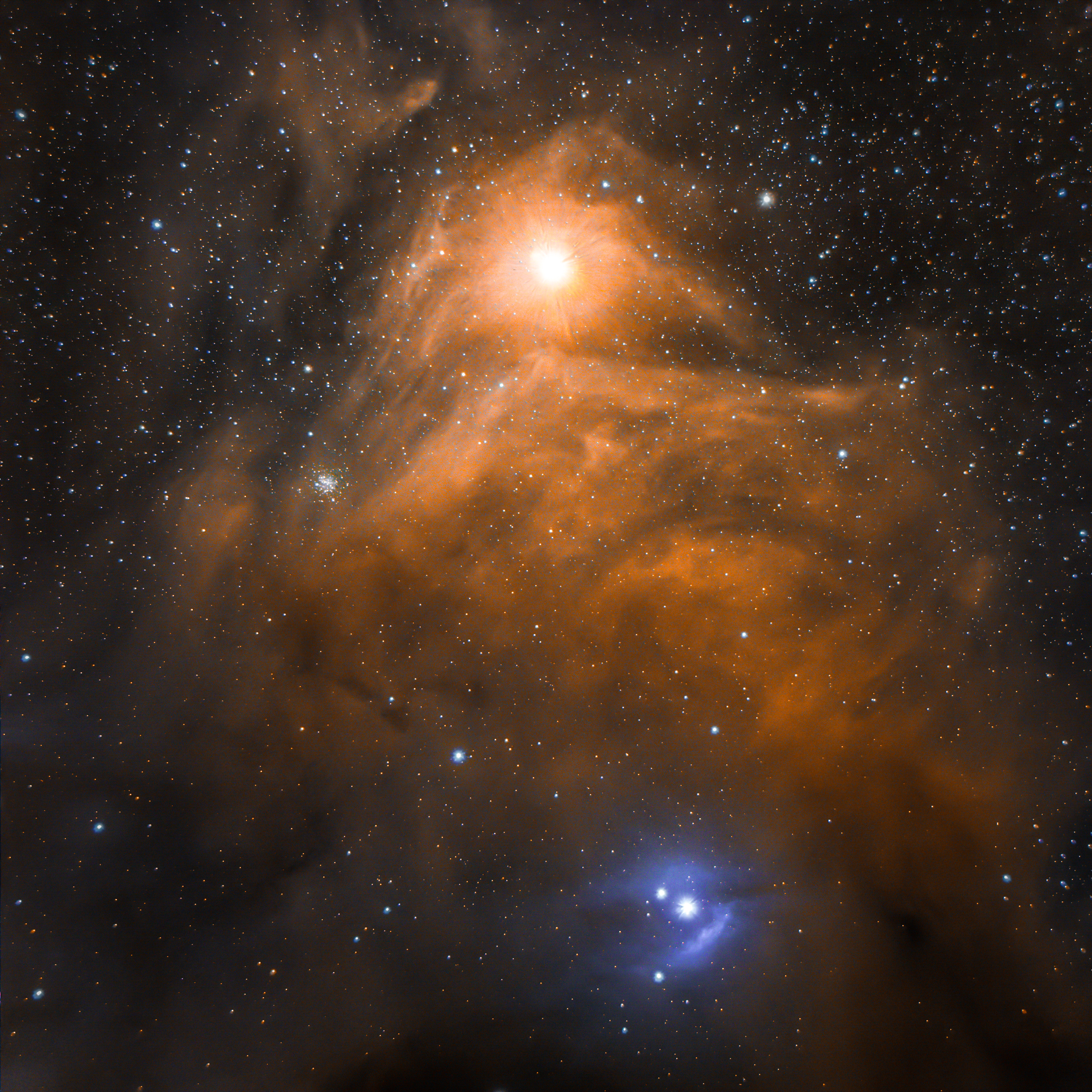
The Heartof the Scorpion
As the last light fades from Hawaiʻi, the southern sky opens into the blazing heart of the Milky Way. Scorpius stretches across the darkness with fiery Antares at its center, while Sagittarius points toward the crowded core of our galaxy. Star clouds, dark dust lanes, glowing nebulae, and ancient clusters fill this part of the sky—one of the richest regions visible from Earth.
This is the stage for the night ahead. We’ll begin by finding our place beneath the constellations, then move between the eyepiece and the imaging system as the sky deepens overhead—seeing bright deep-sky objects directly, while the cameras gather light and slowly reveal the color and structure hidden beyond what our eyes can see alone.
A fast-moving tour through some of September’s best visual and imaging targets. The exact lineup changes with the sky, but these are the kinds of objects we’ll be chasing.
- Antares & Rho Ophiuchi — fiery color, reflection dust, and one of the richest fields near Scorpius.
- Lagoon Nebula · M8 — a huge bright emission nebula and one of the night’s best visual targets.
- Trifid Nebula · M20 — red emission, blue reflection, and dark lanes packed into one field.
- Swan / Omega Nebula · M17 — a bright sweeping star-forming region with obvious structure.
- Eagle Nebula · M16 — a young cluster embedded in glowing hydrogen.
- Mizar & Alcor — the famous naked-eye pair in the Big Dipper’s handle, with Mizar revealing a beautiful double-star view through the telescope.
- Ring Nebula · M57 — a small, sharp planetary nebula that looks like a smoke ring in space.
- Dumbbell Nebula · M27 — larger and brighter, excellent both visually and in images.
- M6 & M7 — sparkling open clusters set against the southern Milky Way.
Reserve your night under the stars.
Limited to ten guests so everyone has meaningful telescope time, room to move between both observing systems, and plenty of time for questions.
Up to 10 guests. Your selection is added directly to the cart.