
DEER LICK
GROUP
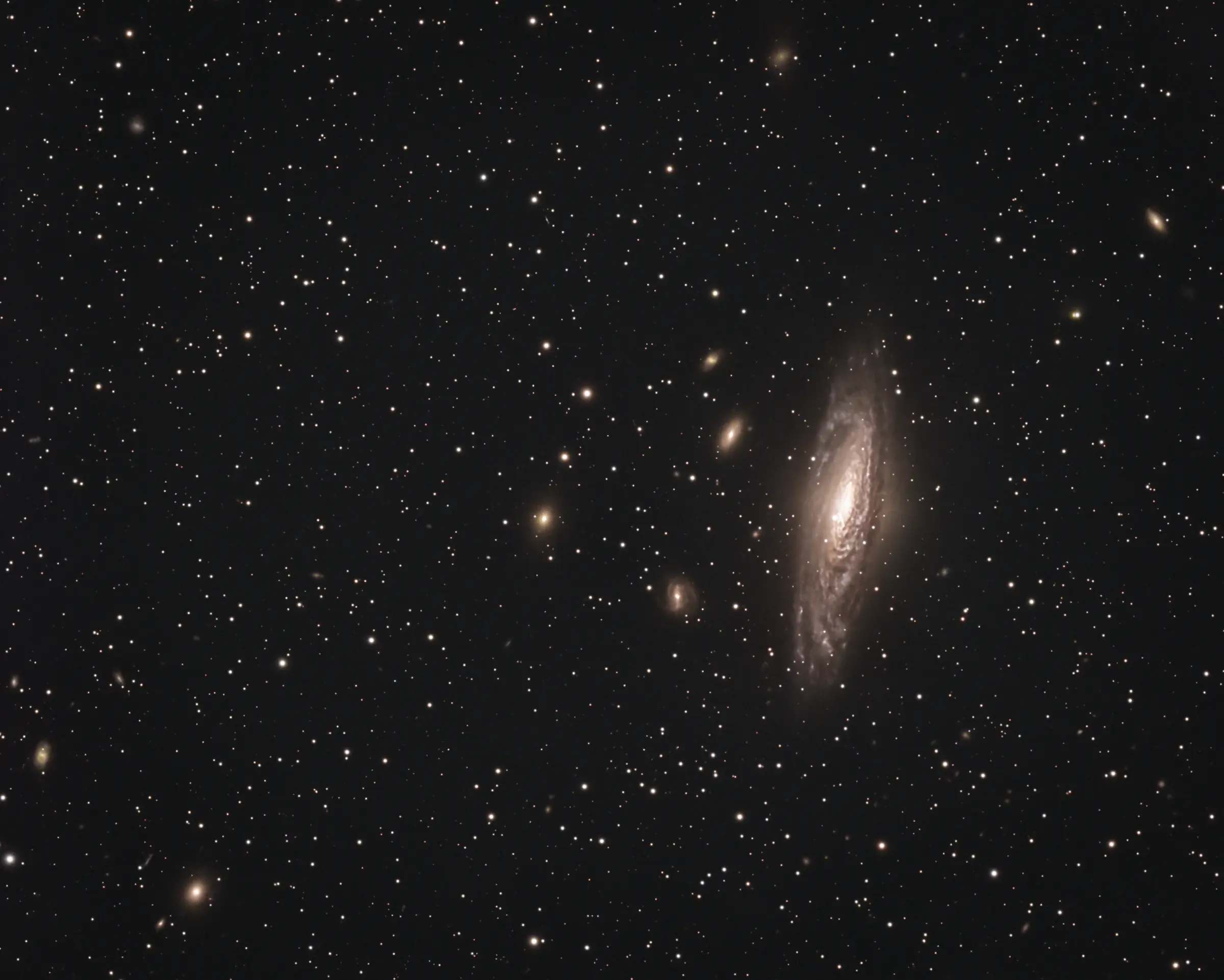
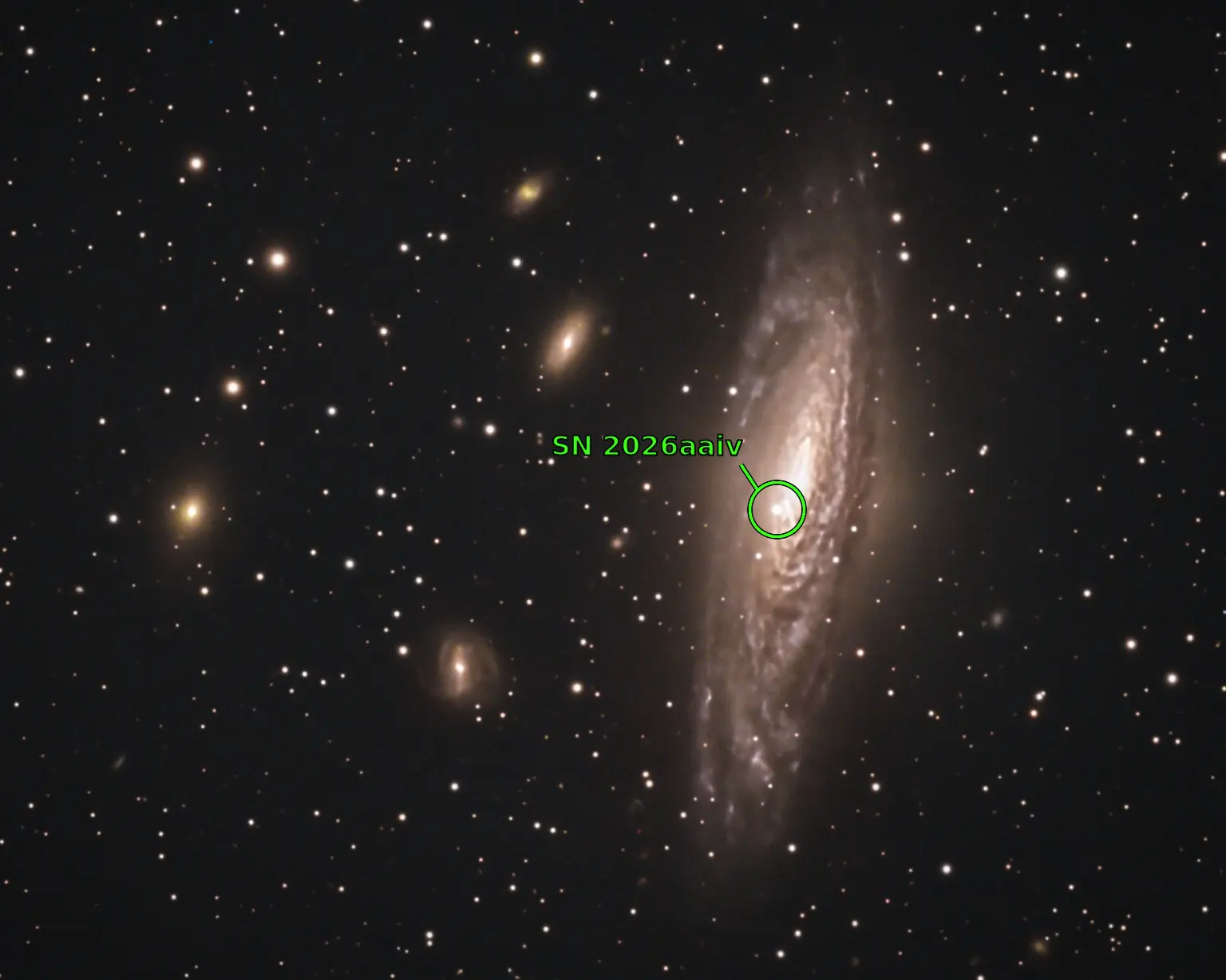
A layered field of galaxies centered on NGC 7331—and, in September 2026, the light of a supernova that began its journey roughly 45 million years ago.
 1 / 2
 2 / 2
The Deer Lick Group is a striking line-of-sight gathering in Pegasus. The dominant galaxy, NGC 7331—also cataloged as Caldwell 30—lies about 45 million light-years away. Seen at a steep angle, its dusty disk, bright central bulge, and rich spiral structure make it one of the sky’s finest galaxy targets.
The four much smaller-looking galaxies nearby—NGC 7335, NGC 7336, NGC 7337, and NGC 7340—are nicknamed the “fleas.” They are not close companions of NGC 7331; they sit hundreds of millions of light-years farther away, creating a dramatic false grouping through chance alignment.
This Deep Sky Hawaiʻi image also records SN 2026aaiv, a Type Ia supernova near the core of NGC 7331. First detected by the ATLAS survey on September 1, 2026, its light crossed roughly 45 million years of space before reaching Earth.
The nickname “Deer Lick Group” belongs to modern observing culture: NGC 7331 is the great galaxy, while the tiny background galaxies scattered beside it are affectionately called its “fleas.” The playful name turns an accidental alignment into one of the deep sky’s most memorable visual stories.
The field lies in Pegasus, the winged horse of Greek mythology. Pegasus sprang from the blood of Medusa and later carried the hero Bellerophon into battle against the Chimera. In the night sky, the Great Square of Pegasus is the bright landmark that leads observers toward NGC 7331.
Press Play to follow Matar to Deer Lick Group. The guide identifies the constellation, traces the landmarks, then finishes with a precise bullseye.
Find
Deer Lick Group
Follow the stars to Deer Lick Group.
A guided star hop to Deer Lick Group.
Tap Play to begin.
Chart notes & credits
This is a landmark chart, with north up and east left at its centre, rather than a live view for a particular date or horizon. Dashed lines connect catalogue landmarks; they are directions to sweep, not exact extensions of stellar pointer lines. Distances and directions are calculated from catalogue coordinates. Bullseyes mark reference positions, not objects’ size or visible brightness. The sky’s orientation changes as it moves. Star symbols are enlarged for clarity. Stars: ESA Hipparcos catalogue. Constellation lines: Stellarium Modern skyculture, adapted under CC BY-SA 4.0. Deep-sky reference positions: OpenNGC; individual source links below where applicable. Reference 1.
Select Play to begin. Tap the sky to pause or resume. Four step buttons revisit each landmark. The guide finishes with a stationary bullseye. Replay starts again. Reduced-motion preferences keep the waiting globe still.