
DUMBBELL
NEBULA
The glowing atmosphere of a dying star, expanding into space in one of the brightest planetary nebulae visible from Earth.
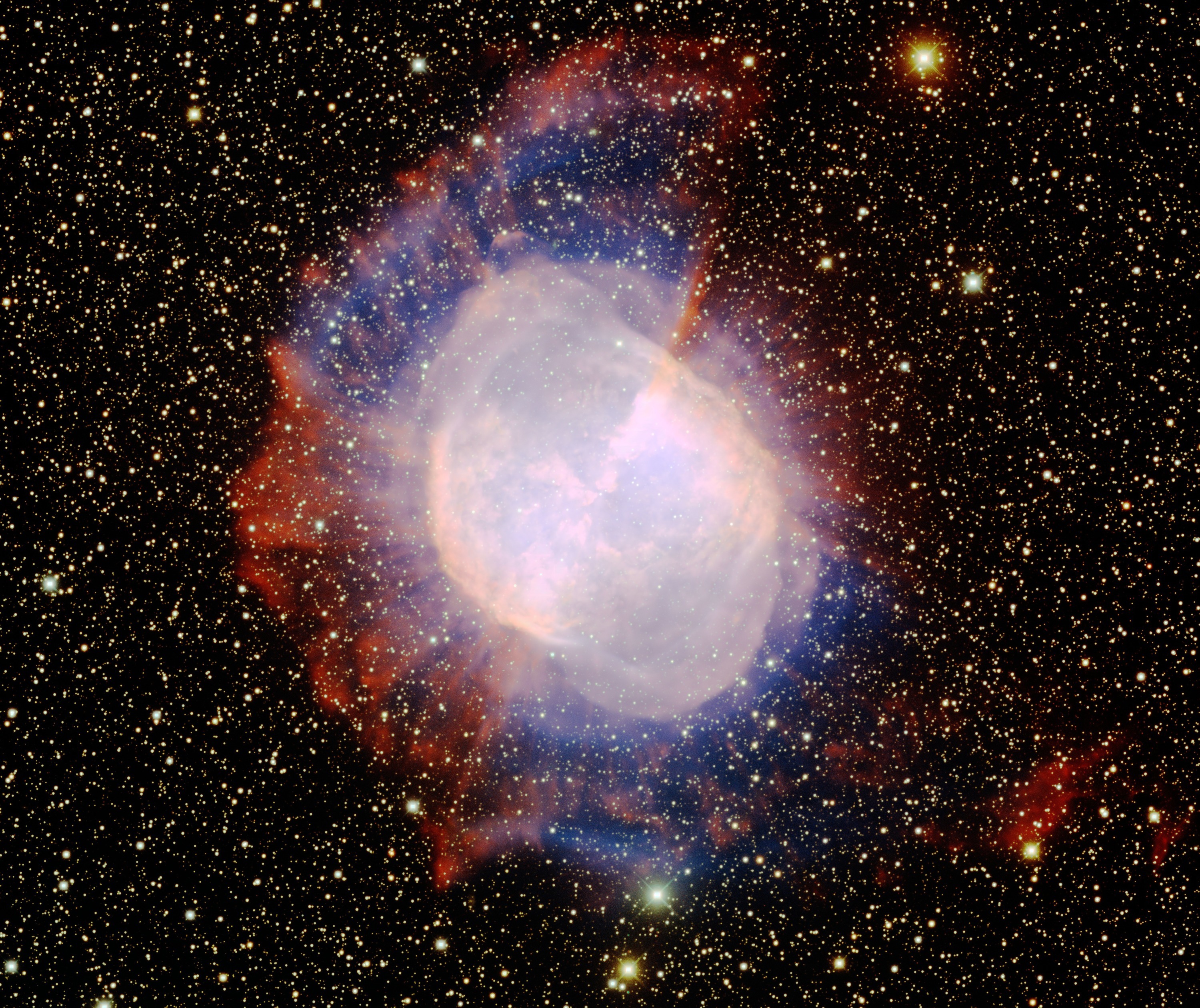
The Dumbbell Nebula is the expelled outer atmosphere of a star that has left the red-giant stage. The hot stellar remnant at its center ionizes the surrounding gas, causing oxygen, hydrogen, and other elements to glow in a large expanding shell.
M27’s apparent hourglass or dumbbell shape is partly a matter of geometry. Its three-dimensional structure includes brighter lobes and fainter outer material, and deep exposures reveal a much larger halo beyond the familiar central body.
M27 is a planetary nebula seen from an angle that makes its brighter bipolar structure resemble a dumbbell. The central white dwarf is the exposed core of the original star, while knots and filaments in the expanding gas record uneven mass loss during the star’s final stages. Very deep images reveal a much larger, fainter halo beyond the bright shape familiar through smaller telescopes.
Inside the Dumbbell.
Messier 27
Vulpecula
A star,
coming undone.
That familiar dumbbell is a star’s outer atmosphere, cast into space near the end of its life. The two bright lobes are the most obvious part of a much larger cloud. This is stellar material being returned to the galaxy.
Open the full-resolution image ↗Explore the science ↗
M27 lies in Vulpecula, the Little Fox. The constellation is not ancient Greek; Johannes Hevelius introduced it in the seventeenth century as a fox carrying a goose through the rich Milky Way between Cygnus and Aquila.
The goose eventually disappeared from most modern star maps, leaving only the fox. The Dumbbell Nebula’s own name is similarly visual and modern, created from the shape astronomers saw through telescopes rather than inherited from ancient sky lore.
Vulpecula is another constellation created in the early-modern era rather than inherited from Greek antiquity. Hevelius originally depicted it as Vulpecula cum Ansere—the Little Fox with the Goose—showing a fox carrying a goose in its jaws. The goose later disappeared from the official constellation name, leaving the fox as a quiet remnant of a once more elaborate celestial scene.
Press Play to follow Gamma Sagittae to Dumbbell Nebula. The guide identifies the constellation, traces the landmarks, then finishes with a precise bullseye.
Find
Dumbbell Nebula
Follow the stars to Dumbbell Nebula.
A guided star hop to Dumbbell Nebula.
Tap Play to begin.
Chart notes & credits
This is a landmark chart, with north up and east left at its centre, rather than a live view for a particular date or horizon. Dashed lines connect catalogue landmarks; they are directions to sweep, not exact extensions of stellar pointer lines. Distances and directions are calculated from catalogue coordinates. Bullseyes mark reference positions, not objects’ size or visible brightness. The sky’s orientation changes as it moves. Star symbols are enlarged for clarity. Stars: ESA Hipparcos catalogue. Constellation lines: Stellarium Modern skyculture, adapted under CC BY-SA 4.0. Deep-sky reference positions: OpenNGC; individual source links below where applicable. Reference 1.
Select Play to begin. Tap the sky to pause or resume. Four step buttons revisit each landmark. The guide finishes with a stationary bullseye. Replay starts again. Reduced-motion preferences keep the waiting globe still.