

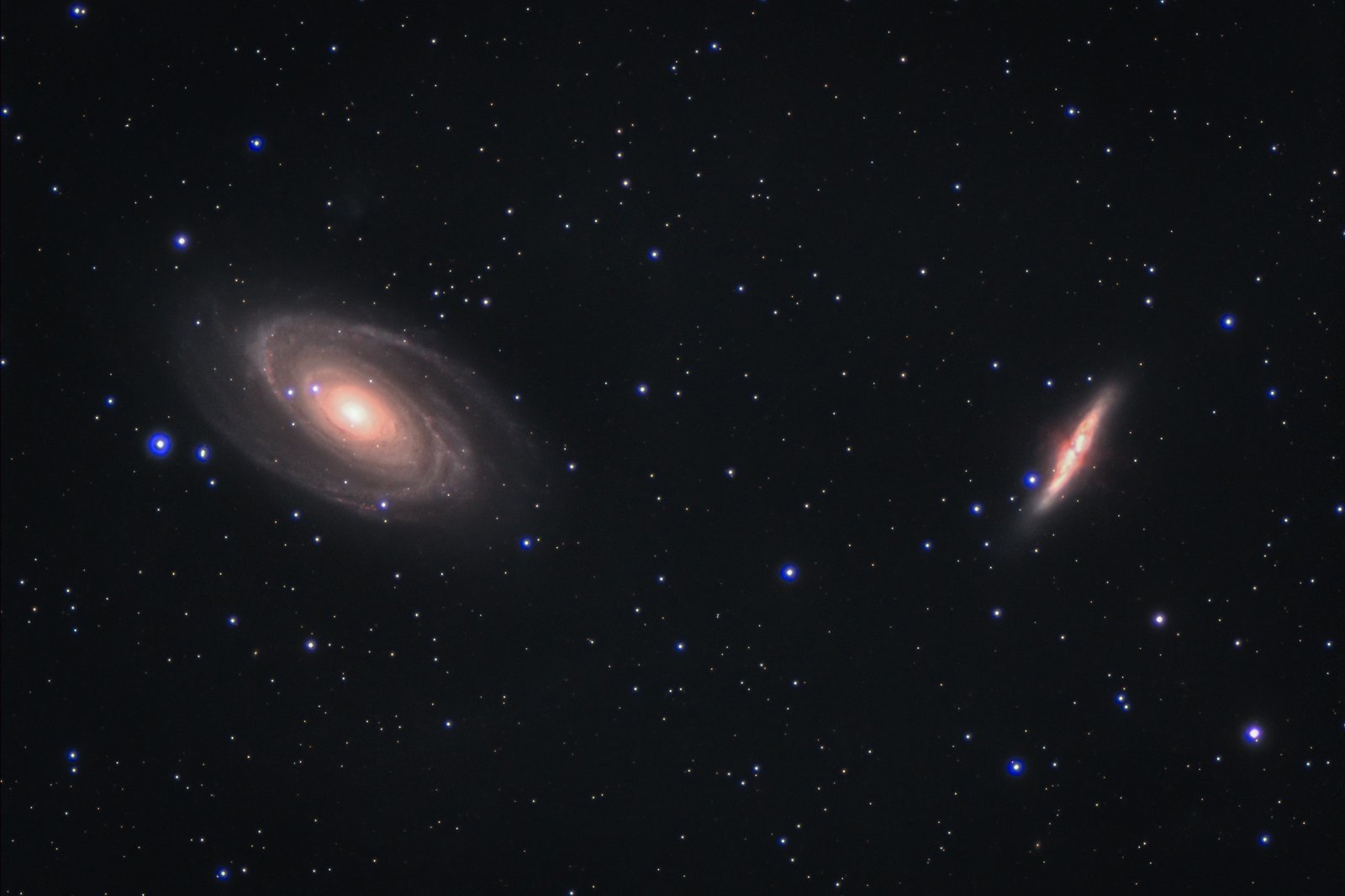
The Bode’s Galaxy & Cigar Galaxy — A Cosmic Interaction in Motion
In the northern constellation of Ursa Major, far beyond the familiar stars of the Big Dipper, lies one of the most compelling galaxy pairs visible from Earth: M81 (Bode’s Galaxy) and M82 (the Cigar Galaxy). Though they appear side by side in the sky, these two galaxies could not be more different in structure, behavior, and energy—and together, they tell a powerful story of gravitational interaction and galactic evolution.
Located approximately 12 million light-years away, this pair forms the core of the M81 Group, a nearby collection of galaxies bound together by gravity. What makes M81 and M82 especially fascinating is that they are actively influencing each other, locked in a slow cosmic dance that has dramatically shaped both of their appearances.
M81 — Bode’s Galaxy
M81 is a grand design spiral galaxy, often considered one of the most pristine and well-defined spirals observable from Earth. Its sweeping arms wrap elegantly around a bright central core, glowing with the combined light of billions of stars.
Spanning roughly 90,000 light-years across, M81 is similar in size and structure to our own Milky Way. Its spiral arms are rich with young, hot stars, glowing in soft blues, while darker lanes of interstellar dust trace the structure of the galaxy like veins.
At its center lies a supermassive black hole, quietly influencing the motion of stars in the core. Compared to more active galaxies, M81’s nucleus is relatively calm—but it still emits measurable radiation across multiple wavelengths.
What makes M81 particularly valuable to astronomers is its clarity. With relatively low amounts of obscuring dust compared to other spirals, it serves as an excellent laboratory for studying:
- Spiral arm structure
- Star formation patterns
- Galactic dynamics
In many ways, M81 represents a stable, mature galaxy—but its companion tells a very different story.
M82 — The Cigar Galaxy
Just a short distance away lies M82, a galaxy that appears stretched and chaotic, earning it the nickname the Cigar Galaxy. Unlike the orderly spiral of M81, M82 is an irregular, edge-on galaxy undergoing an intense period of star formation known as a starburst.
This activity is not random—it is the direct result of gravitational interaction with M81. Over the past few hundred million years, close passes between the two galaxies have triggered waves of compression within M82, collapsing gas clouds and igniting rapid star formation.
The result is a galaxy producing stars at a rate 10–100 times faster than typical galaxies.
This extreme activity has consequences. Massive young stars live fast and die violently as supernovae, injecting enormous amounts of energy back into the galaxy. This drives powerful galactic winds, blasting gas and dust out of M82’s core in dramatic streams that extend thousands of light-years into space.
These outflows are especially visible in hydrogen-alpha light, where they appear as fiery red filaments erupting perpendicular to the galaxy’s disk—giving M82 its explosive, almost violent appearance.
Hidden within its dusty core are countless newly formed stars, many still obscured in visible light but revealed through infrared observations.
A Gravitational Connection
Though they look like separate objects, M81 and M82 are deeply connected. Their mutual gravitational influence has:
- Distorted M82’s structure
- Triggered its starburst activity
- Created streams of hydrogen gas stretching between galaxies
This interaction is a glimpse into a common process in the universe: galactic encounters and mergers. While M81 itself remains relatively undisturbed, M82 bears the visible scars of these close encounters.
Over billions of years, such interactions can lead to galaxies merging completely, reshaping their structure and triggering new waves of star formation.
Observing M81 & M82
For observers in the Northern Hemisphere, this pair is a favorite target thanks to its brightness and proximity.
- M81 appears as a soft, glowing oval in small telescopes, with hints of a bright core. Under darker skies and larger apertures, subtle spiral structure begins to emerge.
- M82 is often the more striking visual object, appearing as a thin, elongated streak. With good conditions, observers can detect its mottled, irregular structure.
For astrophotographers, this pair is a dream target. Even modest focal lengths can capture both galaxies in the same frame, while longer focal lengths reveal intricate details:
- M81’s delicate spiral arms
- M82’s turbulent dust lanes and explosive outflows
Why This Pair Matters
M81 and M82 are more than just a visually appealing duo—they are a living example of how galaxies evolve through interaction.
They show us that galaxies are not static islands in space, but dynamic systems constantly shaped by gravity, collisions, and internal processes. M81 represents stability and structure, while M82 reveals what happens when that stability is disrupted.
Together, they offer a rare opportunity to witness both sides of galactic evolution at once—calm and chaos, order and upheaval—playing out across millions of light-years.
oej qwjrf opsdff