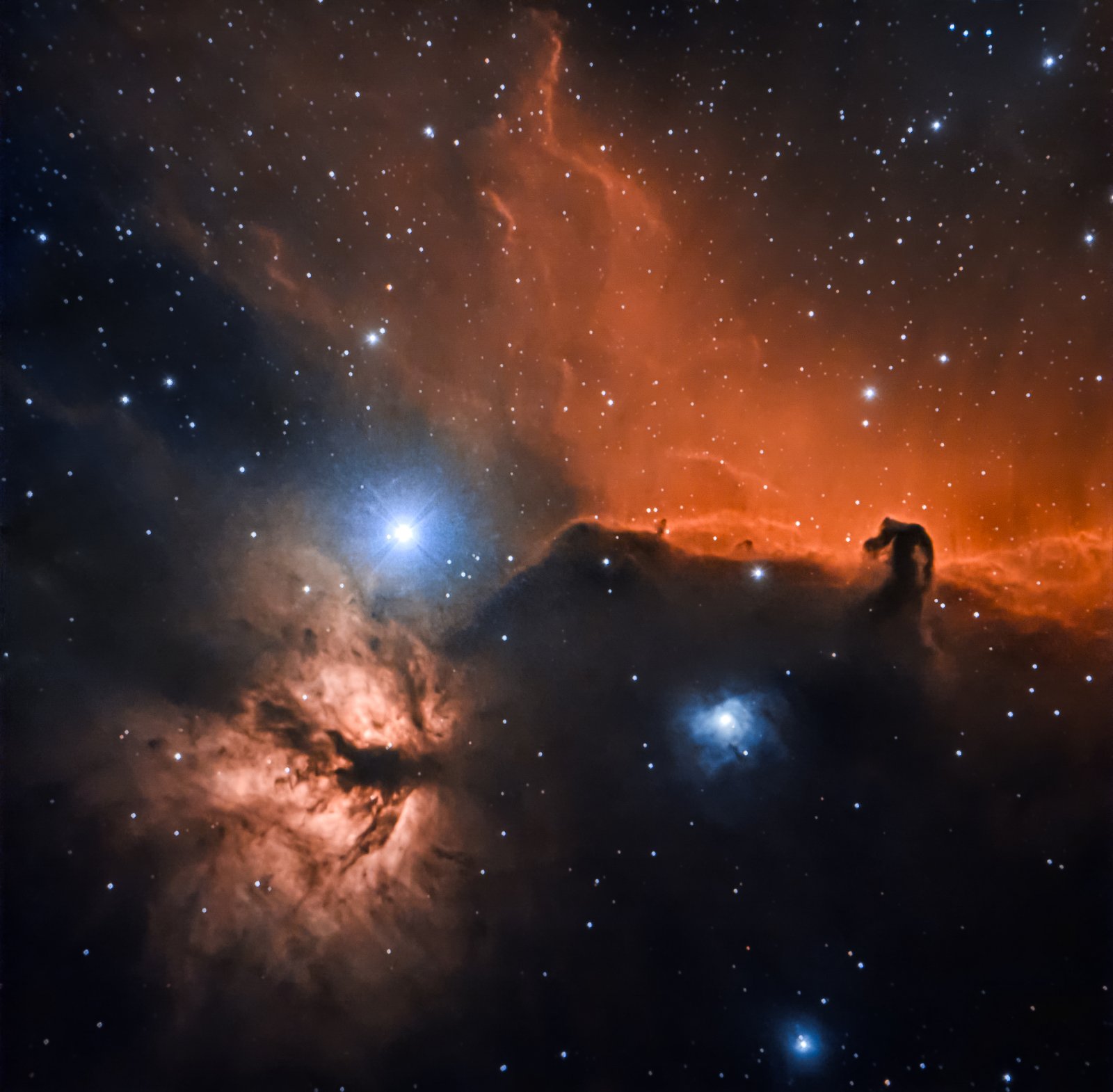
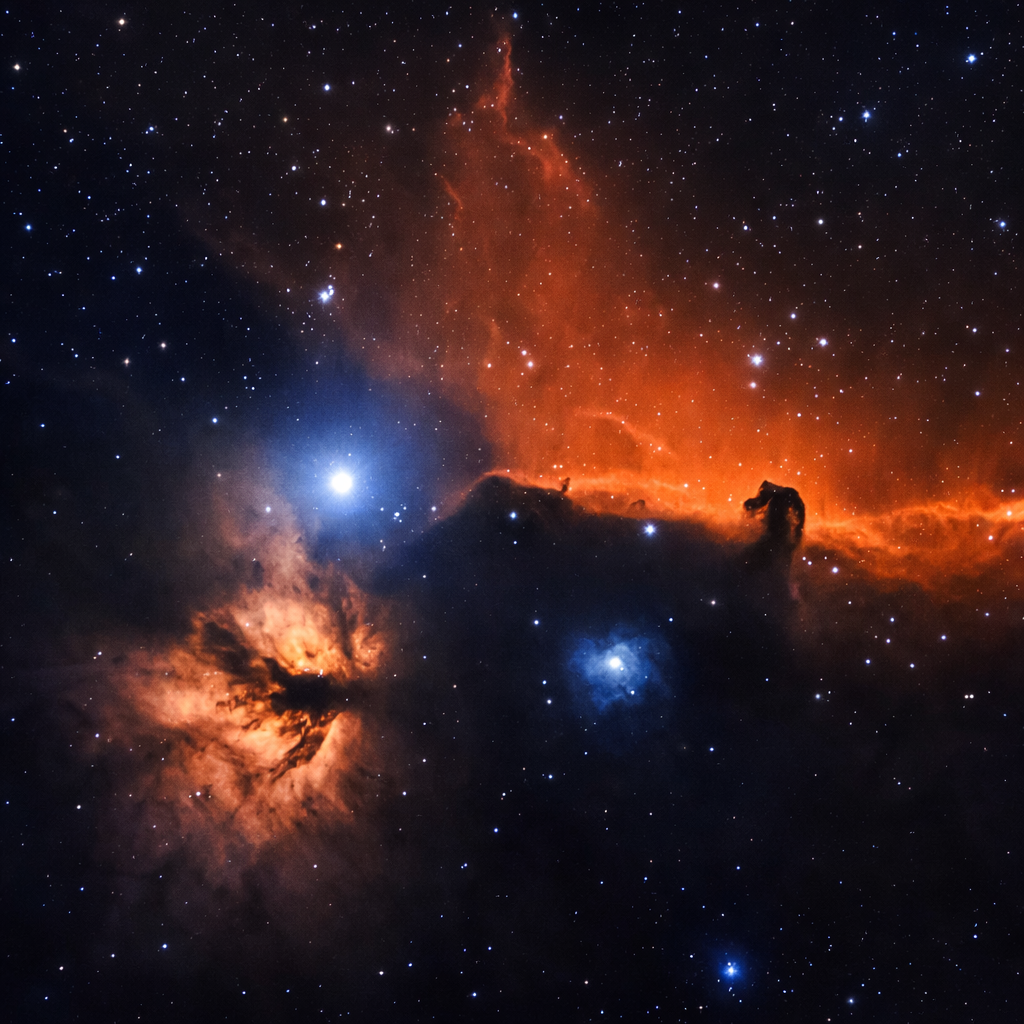
The Horsehead Nebula, formally known as Barnard 33, is not a glowing cloud of gas, but rather a dark nebula—a dense concentration of cold dust and gas that blocks the light from the bright emission nebula behind it, IC 434. This contrast is what creates the unmistakable silhouette resembling a horse’s head.
Located roughly 1,375 light-years away in the constellation Orion, the Horsehead is part of the larger Orion Molecular Cloud Complex—a massive stellar nursery stretching across hundreds of light-years. The dark structure itself spans about 3.5 light-years across, though its apparent size in the sky is quite small, making it a challenging target for both visual observers and astrophotographers.
What makes the Horsehead particularly fascinating is that it is actively evolving. The intense ultraviolet radiation from nearby massive stars—especially Alnitak—is slowly eroding the nebula through a process known as photoevaporation. Over time, this iconic shape will gradually dissipate, likely vanishing within a few million years.
Inside the nebula, astronomers have detected dense clumps of gas that may eventually collapse under their own gravity to form new stars. In this sense, the Horsehead is not just a silhouette—it is a region caught in the delicate balance between destruction and creation.
The Flame Nebula (NGC 2024)
Just a half-degree away from the Horsehead lies the Flame Nebula, or NGC 2024, a bright and chaotic region of glowing gas and dust. Unlike the Horsehead, the Flame is an emission nebula, meaning it shines due to ionized hydrogen gas energized by nearby stars.
At the heart of the Flame lies a young star cluster, mostly hidden behind thick lanes of dust. These stars are extremely hot and emit intense ultraviolet radiation, which ionizes the surrounding hydrogen gas, causing it to glow in deep shades of red—particularly visible in hydrogen-alpha wavelengths.
The dark filaments running through the Flame are cold dust lanes, obscuring parts of the nebula and giving it its fiery, branching appearance. Infrared observations reveal what visible light cannot: a dense population of newly formed stars still embedded within the cloud.
Like the Horsehead, the Flame Nebula is part of the same stellar nursery and sits at approximately the same distance from Earth. However, it represents a more active phase of star formation, where new stars are already influencing their environment.
A Region Shaped by Stellar Forces
The proximity of these two nebulae is not coincidental—they are both shaped by the powerful radiation and stellar winds of nearby massive stars, particularly Alnitak. This star acts as both a creator and destroyer: its radiation illuminates IC 434, reveals the silhouette of the Horsehead, and simultaneously erodes the surrounding clouds.
This interplay between radiation, gravity, and gas dynamics is a fundamental process in astrophysics. Regions like this provide astronomers with a natural laboratory to study:
- Star formation and early stellar evolution
- The impact of massive stars on their surroundings
- The lifecycle of interstellar clouds
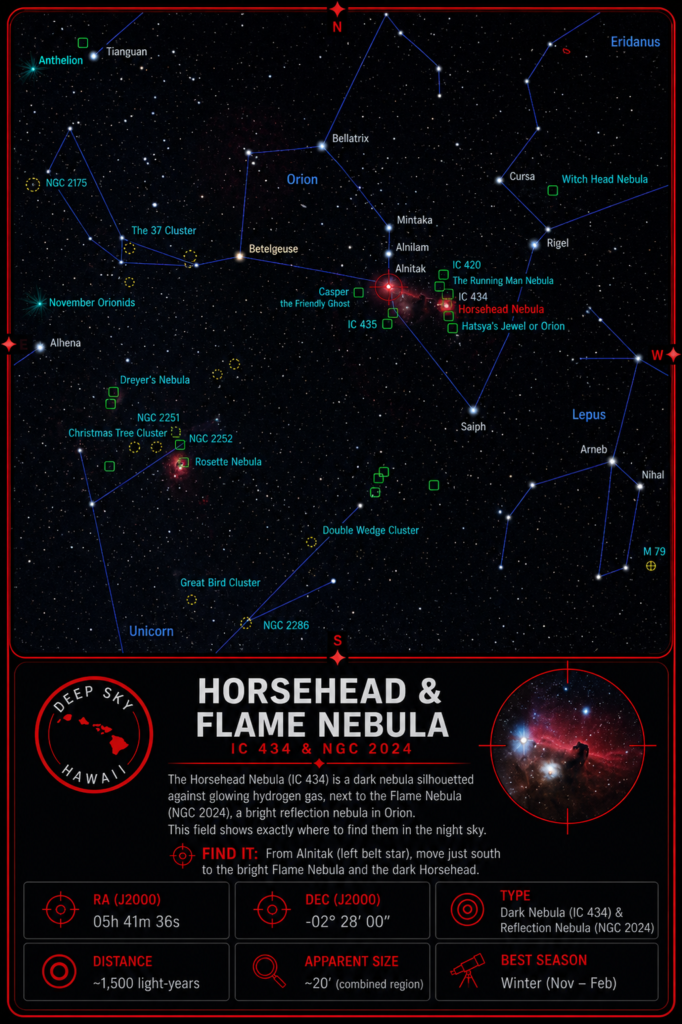
Observing the Horsehead & Flame
Despite their fame, the Horsehead Nebula is notoriously difficult to observe visually. It requires:
- Dark skies
- A relatively large telescope
- A hydrogen-beta (Hβ) filter for best contrast
Even then, the Horsehead appears as a faint notch against the glowing background of IC 434.
The Flame Nebula, on the other hand, is much easier to detect. Under dark skies, it can be seen in moderate telescopes as a bright, irregular glow near Alnitak, with visible dark lanes cutting through its structure.
For astrophotographers, this region is a favorite target. Narrowband imaging—especially in H-alpha—reveals incredible detail in both nebulae, bringing out the intricate structures of gas, dust, and ionization fronts.
Why This Region Matters
The Horsehead and Flame Nebulae are more than just beautiful objects—they are snapshots of cosmic evolution in action. They show us how stars are born from cold clouds, how massive stars reshape their environment, and how the delicate balance between creation and destruction governs the structure of our galaxy.
When you look at this region, you are witnessing a process that has been ongoing for millions of years—and will continue long after the familiar shape of the Horsehead has faded into the interstellar medium.