 The Triangulum Galaxy — A Spiral Without a Center
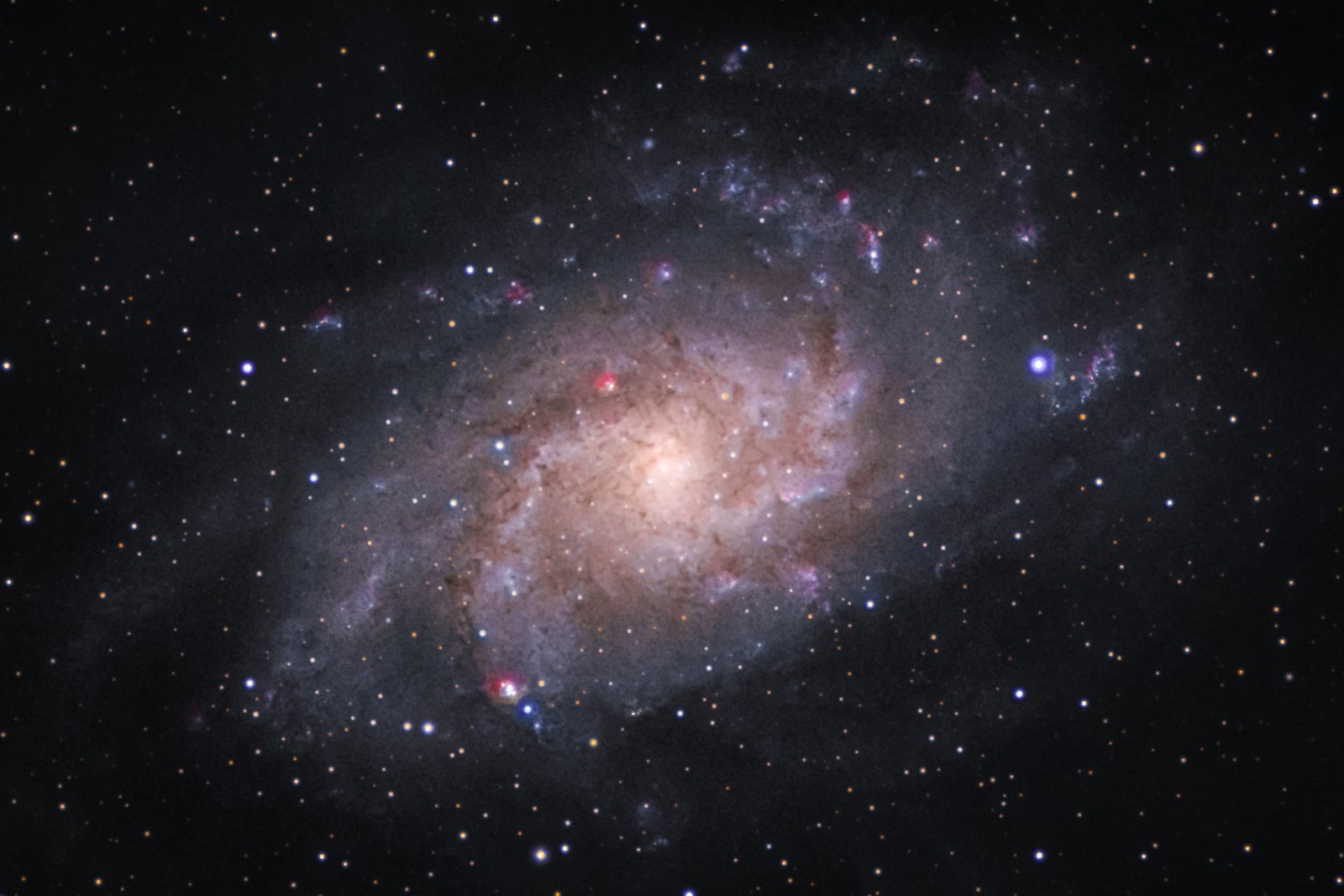
Drifting quietly in the constellation Triangulum lies one of the most understated yet scientifically rich galaxies in the night sky: M33, the Triangulum Galaxy. Overshadowed by its more famous neighbors—the Andromeda Galaxy and our own Milky Way—M33 is often overlooked. But for those who take the time to study it, this galaxy reveals an extraordinary window into star formation, galactic structure, and the quieter side of cosmic evolution.
Located approximately 2.7 million light-years away, M33 is the third-largest member of our local galactic neighborhood, the Local Group. Unlike the massive Andromeda Galaxy, however, M33 is smaller, looser in structure, and far less dominated by a central core. And that difference is exactly what makes it so interesting.
A Galaxy Alive with Star Formation
M33 is one of the most active star-forming galaxies in the Local Group. Its spiral arms are packed with HII regions—vast clouds of ionized hydrogen glowing from the radiation of newly formed stars.
The most famous of these is NGC 604, one of the largest star-forming regions known in any nearby galaxy. This massive stellar nursery spans over 1,500 light-years, dwarfing even the Orion Nebula by an enormous margin. Inside, hundreds of massive, young stars are forming, flooding the surrounding gas with intense ultraviolet radiation.
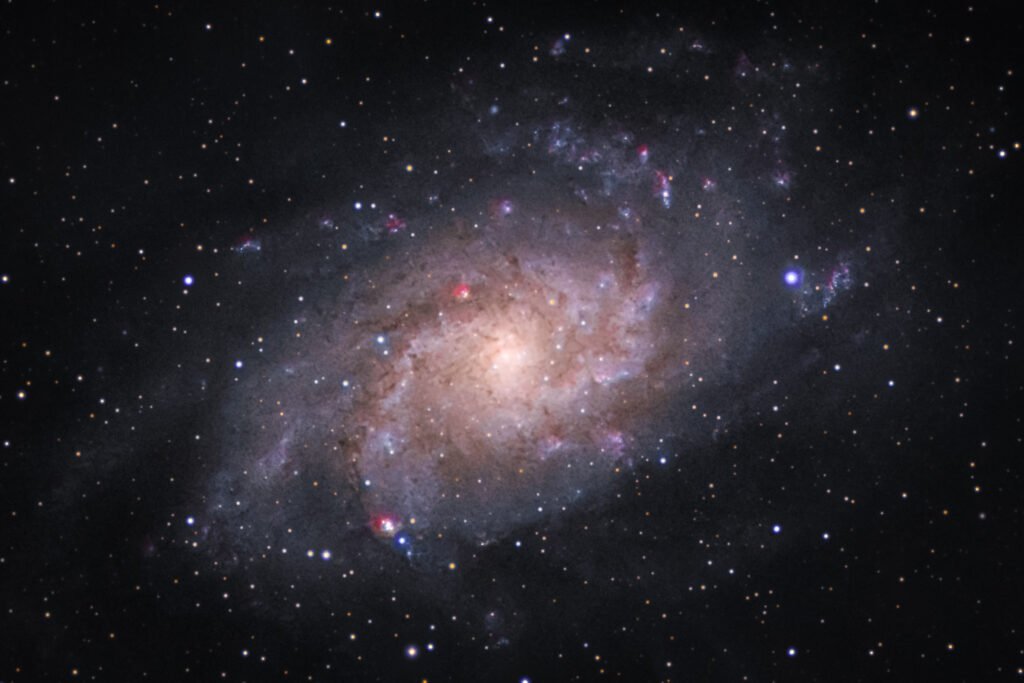
Across the galaxy, these regions appear as scattered knots of pink and red, giving M33 a distinctly textured, almost granular appearance in astrophotography. Rather than smooth spiral arms, you see a galaxy broken into pockets of creation—each one a site of ongoing stellar birth.
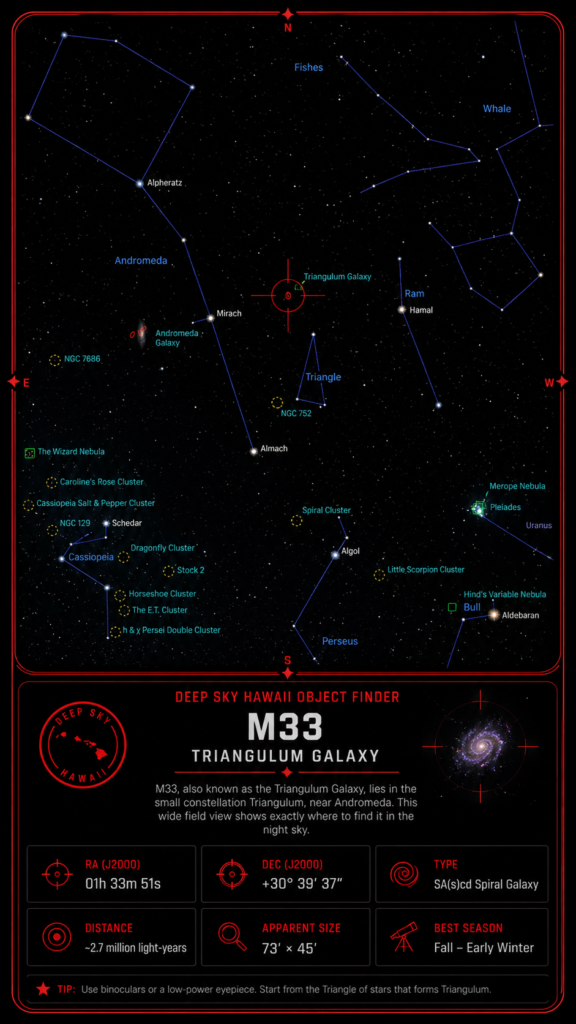
Observing the Triangulum Galaxy
Despite being relatively close, M33 is not an easy visual target. Its light is spread out over a large area, giving it a low surface brightness. Under dark skies, it can be seen with the naked eye as a faint patch, but it truly comes alive with optical aid.
- In small telescopes, it appears as a diffuse glow with hints of structure
- Larger apertures begin to reveal patchiness and subtle spiral features
- Under excellent conditions, bright HII regions like NGC 604 can be detected
For astrophotographers, M33 is a rewarding but demanding target. Its wide angular size makes it ideal for shorter focal lengths, while longer focal lengths allow you to zoom in on individual star-forming regions.
Narrowband imaging, especially in H-alpha, highlights the galaxy’s incredible network of stellar nurseries, turning it into a map of active creation across tens of thousands of light-years.
Why M33 Matters
The Triangulum Galaxy is often described as a “simpler” galaxy—but that simplicity is exactly what makes it valuable.
Without the overpowering influence of a massive central bulge or black hole, M33 offers a clearer view of how galaxies behave when local processes dominate over global structure. It allows astronomers to isolate and study star formation in a way that’s harder to do in larger, more complex systems.
In many ways, M33 is a glimpse into a more fundamental mode of galaxy evolution—one where stars form in scattered pockets, structure emerges organically, and the galaxy grows without a central authority guiding it.
When you look at the Triangulum Galaxy, you’re not just seeing another spiral—you’re seeing a galaxy that plays by different rules. And in doing so, it reveals a deeper truth about the universe: there is no single way for galaxies to exist, evolve, or create the stars that fill the cosmos.
fklsdjfl asdfoiwae iasdjfck
ertoierpsdfk pv posdfsd ;vc